Nivedita Mukerjee
Education consultancy for parents and schools
How to survive this perfect storm and teach life skills to your child?
No eating out. No hugging friends. No inviting people home. No going to people’s homes. No travelling. No theatre. No museum. No hanging out. No school. No college. No canteen. No playground. No…
There are so many “No” category of activities since February 2020 that it feels like a deep dark tunnel with no light at the end in sight. It is confusing for young children and is frustrating for both young and old. Parents, as I speak with them on an ongoing basis, are finding it very difficult to manage their own emotions and regulate the behaviour of their children.
Over these past few months, here is what I have found out while talking to parents that has been helpful. The educator and parent in me looks at it as a great teaching moment for the phenomenal lifeskill of self-regulation.
Why do children and adolescents need to learn to self-regulate, what we as adults know very clearly from the consequences of when we did/when we didn’t? Food, finances, relations…Isn’t it? When we are able to control our behaviour, our emotion, our communication or when we are able to manage procrastination, distraction, dejection – how it influences our decision making capabilities? How those decisions have had a long lasting impact on our own and our dear ones lives and livelihood.
As an educator I have witnessed how self-regulation prepares growing children towards achieving their – not only academic success and avoiding risky behaviour as adolescents but also becoming more productive and healthy as young adults.
Currently, most if not all parents are spending more time with their growing children at home. I see it is a great opportunity to role-model self regulation despite all being under the perfect storm of trying situations, from personal finance and health to the overriding fear of uncertainty.
How to survive this perfect storm and teach life skills to your child? Here are my top 3 tips.
Goal setting : In order to self regulate, it is important to define a Why. For that, setting a goal is key. Giving a voice and choice to children helps in doing that. For eg. the goal could be as basic as – playing. Have a small discussion with your child about it. What does s/he wants to play with (ball/blocks/video game/board game)? Who does s/he want to play with (by themselves/with siblings/with pet/with parent)? Where does s/he want to play (in the back yard/bed room/living room/terrace)? How long does s/he want to play(all morning/all evening/one hour)? What resources s/he would need towards fulfilling this goal (ball/board game/internet/paints)? This will help the child in preparing for it and more often than not, sticking by.
You can role-model it yourself by sharing your plan similarly – whether for a chore or work that you are going to do and circle back by sharing how you could/could not keep to your goal and what could you have done/not done towards the same. This will also help the child to handle either – when all goes per plan or fails. Which factors lead to the success/failure of the plan? Handling the emotions of a failure/partial success of a plan for reasons within/beyond control.
Problem solving : Once the goal is determined and choices are made, as we know, the path to a goal which might be simple or complex is still riddled with uncertainty. It will be in need of chunking and critical thinking. The skill of problem solving by taking apart the problem piece by piece and thinking critically to find a way ahead/around will be needed. What is the kind of flexibility and resilience that is needed to reach that goal that they have set out to achieve?
Adults can use the skills of brainstorming – pooling multiple ideas from different sources; questioning – posing open ended questions of why/how to the problem; reflecting – wondering about alternatives, taking lessons from the past of oneself or others and history. Taking the earlier example of – playing : If the board game pieces/internet is not available what are the other options? If a particular space of choice is not available where else can one play? If the specific play mate is unavailable then who can one play with? If that time length is not possible can it be paced out? This can be applied to complex problems of having limited availability of finances, devices, choices of any kind. The gentle beginnings of this thought process can be initiated and honed by using stories and the characters to discuss the protagonist’s problem, challenges, alternate ways of solving and most definitely by imagining alternate endings of any/all stories that we read or movies that parents watch with their children.
Persisting in the face of a challenge, finding creative work arounds, keeping the head on shoulder with calm and patience are somethings you can share with your child for situations you faced, when you did and when you did not and what was the outcome.
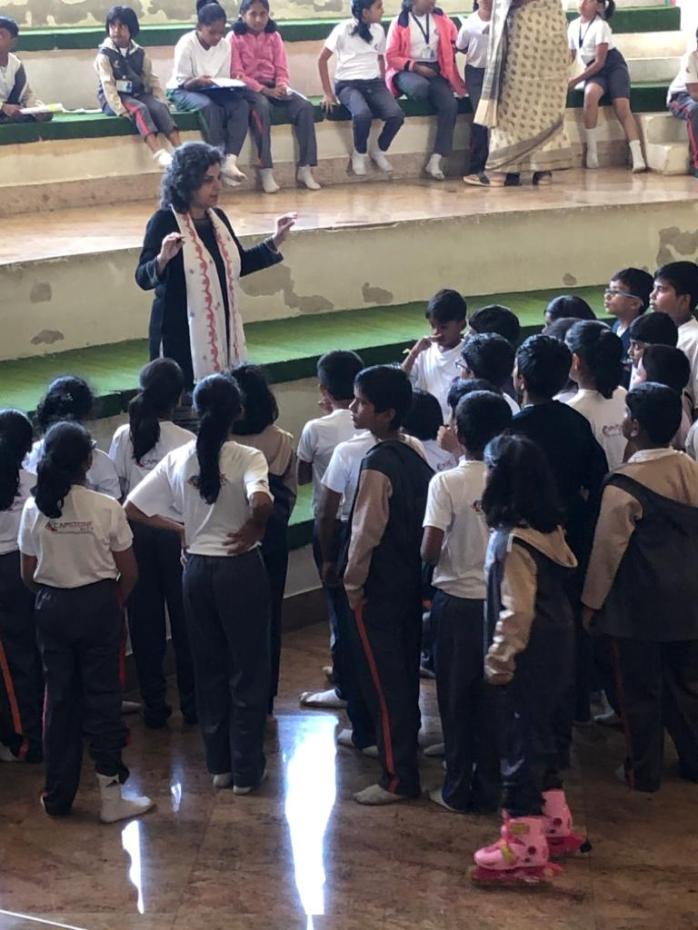
Self restraining: A great skill to build. Preschool teachers practice it with their students regularly by playing the popular game of Freeze Dance/ Statue. I have played it with my students of all years of K12 and actually even undergrad students as well. It is such a full bodied self and group activity that it is enjoyed across ages and promotes quick thinking and restraint at the same time. Playing music and stopping suddenly to freeze motion – calling out for an animal/emotion/character from a movie, any other variation is fun. The reverse, of having the participants move when quiet and freeze when music is on is a good one too. For children it is a practice of restraint as response to a stimulus. For adolescents it builds on this skill and strengthens the part of the brain that helps in keeping a resolve.
As adults, we can role-model this by doing meditation with them. Even working out a quiet time and staying still. Rituals like saying a prayer/gratitude before eating or waiting for all on the table to start/finish a meal or a course of meal is great in building this attitude of self-restraint. You would be able to discuss with your child in a structured way then, what would help in keeping the resolve. How distractions impact one’s journey to a goal and thus what is the result of deviating from the flight path on arrival at the destination.
All of us have been forced into making a sudden transition in our lives due to this pandemic. Emotions of sadness, frustration, aggression, depression are natural. However, the key is to not allow these emotions to be all consuming. It is a life lesson for one and all. We would need to take the responsibility of our own selves, our family and also of those who are finding it a little bit more difficult to grapple with uncertainty because of the uniquely specific situation they are in.
How are you setting an example of being a survivor in your family? In your community? Please share. We are all in the storm together but not in the same boat. We can learn to row better from each other.
Please feel free to share this post with your fellow parents and subscribe to continue to receive posts in your mail.
 Nivedita Mukerjee
Crisp. Well articulated and informative to the core. Much needed for the prevelant situation
LikeLiked by 1 person
Nice thoughts dear
LikeLiked by 1 person
Learning how to manage multiple tasks in a day is also a good skill to teach a child. It allows them to realize that their focus need not just me on play time. But that certain kinds of ‘work’ are also necessary for sustenance ( cooking, doing laundry while enjoying the act with soap and water ) and enjoyable. Even washing dishes. Doing a variety of tasks during the day in a fun manner will teach them that there’s more to life than playing and screen time. And of course, all these are life skills which also provide options for alternate activities
LikeLiked by 1 person
much needed advice during these extraordinary times.
LikeLiked by 1 person
A great, well thought out, clearly articulated article. Yes, life has been engulfed with uncertinies generally, more so now , thanks to COVID. keeping the spirits alive, connecting to near and dear, not letting the fear of uncertainities taking a deep root in the minds and hearts, and believing in the super power in addition to expression of gratitude for being where we are and how we are is my way of surviving this crisis. Thanks for the lessons on self regulation and self restraint
LikeLiked by 1 person