Nivedita Mukerjee
Education consultancy for parents and schools
3-2-1 TUESDAYS WITH MS NIV
Issue # 47 / June 1st 2021
Our children should be able to say that the world is good and, by extension, they are good. When do our children/students think that the world is an extension of themselves? At what age do they start to understand death and mortality? When do they start working with their emotions? What makes learning arts and sciences holistically through the primary and middle ages so important? What kind of exam stress high school students are dealing with? Learning, relationships, growing up, taking responsibility, understanding one’s own strengths and weaknesses, and amidst it all examinations and pandemic… it is a world like never before. Hopefully, some of the following tips and suggestions would help you to teach, understand and parent your growing child. They have no frontal lobe for making all the decisions and yet, we have to ensure that we help them with the process of decision making and, not make the decision for them while at it.
If you have not yet subscribed to my weekly newsletter on education, you can do it today by putting in your email id. It is free 🙂
Three images of the week


Two thoughts of the week
“My advice is, never do tomorrow what you can do today. Procrastination is the thief of time.” – Charles Dickens ‘David Copperfield’
“Help will always be given at Hogwarts to those who ask.” – Albus Dumbledore ‘Harry Potter and the Chamber of Secrets’
One video for the week
Carolin-Anderson believes that the current public school paradigm is not effective in fostering independent thinkers necessary for social renewal. A veteran educator with 30 years of cross-cultural teaching experience, she has an advanced degree in pedagogy, the science and art of instructional theory. Through holistic learning and teaching practices, Carolin-Anderson strives to create a higher level of social justice and well-being by uncovering emotional, social, academic and spiritual/metaphysical potentialities in our children. She now leads a progressive jr. high school program for Waldorf School of Bend.
Guest speak
Biomimicry: Making science education more holistic while connecting learners with Nature.
Have you ever wondered why colours of peacock feathers never fade, even though they are exposed to rain and sunlight? Colours of our fabrics easily fade after a few washes in the rain and exposure to sunlight! Can we use the science behind peacock feather colours, to create fabrics that would retain their colour the same way?
Ever wondered how every tree in this world has been sending water up from its root to every leaf – 24/7, 365 days in a year in its entire lifetime, without using any external electricity or regular breakdowns! Our water pumps work with electricity, yet cannot be operated 24/7 and require regular repairs. Can we use the science behind trees transporting water, to create better ways to transport water?
Ever wondered how the ants work so well in a team ?How do ants find food, carry it back to their colony in a coordinated way, keep their colony clean, take care of the young ones, defend themselves against their enemy while working as a team? Scientist who have studied them for decades inform us that ant colonies work without any leader, manager, CEO or government! It is a ‘self-organized system’! Imagine if your organization, school or city could be run without a head, principal, manager or government? Are there any lessons we can learn from ants to better manage our systems?
Nature has already solved many of the problems we grapple with and in a far more sustainable way! It is the biggest library of ideas. The problem is we don’t know and neither are we taught in our institutions, how to browse this library.
‘Biomimicry’ is a new discipline and approach to solution finding, design and innovation wherein students learn to consciously seek solutions & ideas from nature to solve human challenges.
Nature’s solutions have evolved over a period of 3.8 billion years under the same conditions, which apply to all that exists on our planet. Hence, these ideas are time tested solutions we can learn from, and using natures design principles helps us create sustainable solutions while reducing the risk of damaging the environment.
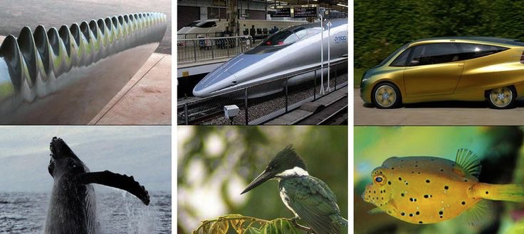
Whale fin inspired bumps on fan blade Kingfisher beak inspired bullet train design Box fish inspired Mercedes
All these inspirations increase efficiency of the products using less energy
How is it relevant to school education?
Biomimicry enables a holistic learning process, where students learn about how nature ‘functions’. When discovering the science behind natural phenomenon, students observe and understand in an integrated and multidisciplinary (Physics, Chemistry, Biology, Maths etc.) way. This also helps in giving a living context to the science they are learning. Biomimicry inculcates a ‘sense of wonder’ about the natural world in learners and deepens their connection with nature – something which is missing in our current education system.
Biomimicry education inculcates holistic learning and a ‘multidisciplinary’ learning mind-set which is integrated with nature. It holds the promise of providing the much needed solution/way ahead to make education more holistic, environmentally conscious and fun! Most importantly it helps our children have a deeper sense of connection and respect for the natural world and become environmentally responsible learner, who are future ready!
“Look deep into nature, and then you will understand everything better.”
– Albert Einstein
Seema Anand & Prashant Dhawan
Co-founders of Biomimicry India
http://www.biomimicryindia.com
_______________________________________________________________________________________________________
Dear reader,
I have been a research scientist, a journalist and an educator for over 3 decades. I read and I write. With this weekly newsletter, I intend to share what I read, learn and experience while I engage with students, parents and teams of teachers across K-12 schools, higher education institutions and ed-tech organisations.
3-2-1 Tuesdays with Ms Niv is a newsletter for you to subscribe and enjoy your learning journey with me. This week, it consists of: 3 images, 2 thoughts and 1 video.
And Finally…


This newsletter is supported by:




 Nivedita Mukerjee