Nivedita Mukerjee
Education consultancy for parents and schools
3-2-1 TUESDAYS WITH MS NIV
Issue #137, 21st February 2023
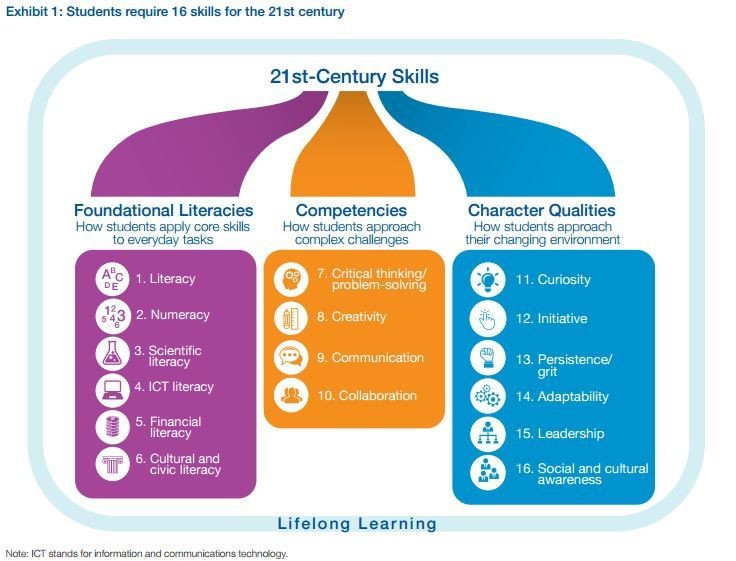
Do you have what it takes to not just survive but thrive in the 21st Century? There is a lot of buzz around 21st-century skills. Now, whose job it is to impart them? School or parents or allied education specialists? Can we hand over this critical job of learning and imparting critical thinking skills to one stakeholder in our child/student’s life? What do you think? What have you done as an educator and/or parent? here are some thoughts for educators and parents to consider and act upon. As of yesterday 🙂
Three Images of the Week


Two Thoughts of the Week
“The 21st century is the century of knowledge. Knowledge, science and education will have the power and strength to embrace the entire universe.”
- Narendra Modi
“The illiterate of the 21st century will not be those who cannot read and write, but those who cannot learn, unlearn, and relearn.”
- Alvin Toffler
One Video of the Week
Changing Role of a Teacher in 21st Century | Dawn Taylor
She inspired everyone to follow the changing ideologies of the world in the field of Education system. She stimulated the thought of turning Educators into “Activators of Learning”. Dawn Taylor is an International Education Consultant and has over 20 years of experience in the field of education.
She is currently working with over 19 schools in India to build a vision for their future and drive forward school improvement. Her vision and focus on scalability and workable solutions aim to start preparing over 30,000 students this year with the skills they require for life.
She is leading over 1,000 teachers in a skills-based revolution within our classrooms, a revolution that is prioritizing the teaching of 21st-century skills. She has trained over 13,000 students in India alone on the development of metacognitive skills: inspiring and activating an army of independent, self-assured learners.
Dear reader,
I have been a research scientist, a journalist, and an educator for over 3 decades. I read and, I write. With this weekly newsletter, I share what I read, learn, and, experience. At the same time, I engage with students, parents, and teams of teachers across K-12 schools, higher education institutions, and ed-tech organizations.
3-2-1 Tuesdays with Ms. Niv is a newsletter for you to subscribe to and enjoy your learning journey with me.
Guest author:
Face The Future – Think Critically!
What is critical thinking?
In the New Vision of Education (2015) report, the World Economic Forum (WEF) defined critical thinking as “the ability to identify, analyse, and evaluate situations, ideas, and information in order to formulate responses to problems”. Critical thinking, defined as such, was one of the ten 21st Century skills the report identified as being imperative for the students of today to master to be able to Face the Future with any degree of competence and confidence.
But what does all that mean? What exactly is critical thinking? How would one (1)identify, (2)analyse, and (3)evaluate? What would those entail? What are the tangible and concrete actions one would have to take? And most importantly, how would you teach all of that to a child or teenager?
To put it simply, thinking critically means thinking beyond the obvious or the superficial. Thinking critically forces you to move beyond being a passive recipient and forces you to become an active participant. When you observe the things happening around you, when you are presented with data or content, when an opinion or thought is shared with you; instead of merely accepting it, you have to process it, break it down and extract meaning or intent from it.
Imagine if an alien species with much better technology than us lands on Earth, gives us a gadget that is supposed to solve all our problems, and flies off into outer-space again. How amazing would that be? A non-critical thinker would start using the gadget as instructed – and for awhile, things would be great as all the problems of humanity magically vanished. But a critical thinker would do more than start using the gadget. They might for example start thinking about what constitutes the object in terms of its mechanisms and if it can be reproduced. They might start thinking about how it works and why it has the effects that it does. They might start thinking about what side-effects it might produce or unintended consequences it might set off. They might start thinking about why the aliens left the gadget with us in the first place and what the aliens’ motives might be.
Why is critical thinking important?
So why is any of that important? Why not just use the alien gadget and enjoy a problem-free world? It sure seems like a lot of unnecessary effort and a whole lot of bother.
Well, we’d want to know, wouldn’t we, if the alien species gave us that gadget as a precursor to a full scale invasion because it emitted rays that could brainwash us to submission while it innocently seemed to solve all our problems? Or if some alien element was being released into the atmosphere which would eventually terraform our Earth into something unliveable for us and only conducive for them? Maybe there is no reason to be cynical – maybe the aliens were truly altruistic and only had good intent. Then we’d want to know, wouldn’t we, how to repair or reproduce the gadget should it suddenly break down and turning it off and on again does not solve the problem?
While this seems way too far off in the future and more the plot of a B-grade science fiction movie than real life, the core of the argument is relevant to our world and our lives today. We need to think critically so we are not taken for fools, so we are not taken by surprise, and so we understand better.
We might not have alien gadgets but we are surrounded by man-made gadgets, all of which promise to make some aspects of our lives better. And as we move into the future, more and more gadgets will be introduced to our lives. We should critically think about those gadgets the same way we would an alien gadget for all the same reasons.
Another feature of the advancement of technology is the constant barrage of information and news from the internet and social media. Critical thinking allows us to decipher this information and its value to us. How much of it is fake? How much of it is manipulative? How much of it is skewed?
Being able to think critically allows us to identify the cause of problems at their root so we can eliminate them rather than constantly looking for quick fixes. Being able to think critically allows us to spot loopholes and gaps so we can avoid potential problems in the first place.
But beyond all that, we need to develop the skill of critical thinking because it’s the smart and the right thing to do. It’s an important human skill to have. It’s really that simple. Being able to think critically, and exercising that ability regularly, makes us better at being human. And being better at being human as we Face the Future is always important, especially as we move into a world with better machines, better robots, and better everything-that-is-not-human.
How is critical thinking manifested?
Well, that’s great, you might exclaim. You’ve convinced me that critical thinking is important, you might concede. But what should I do to become a critical thinker, you might ask.
It’s not that hard really. The first step of course is awareness of the idea of critical thinking itself and the need for it. Once that awareness is achieved, the next few steps, hopefully, become seamless.
The next step is practice. Start thinking critically of everything around you – every situation, every piece of information, every idea. Ask as many questions about everything until you fully understand every aspect of it – ask until there are no more questions left to ask.
Ask questions like what it might imply, what hidden subtext there might be, who was involved and if they have any underlining motive or agenda. Ask questions like what the impetus was, why it turned out a certain way, and what possible consequences there might be. Ask questions like whose point of view was presented, is it comprehensive, and if you agree or disagree with it and why.
Question assumptions, question logic, question perspectives. Identify connections, identify inconsistencies, identify gaps. Determine relevance, determine significance, determine consequence.
As with the acquisition of any skill, this will be hard at first but constant practice will make it a habit and lead to mastery. And with mastery, you will find that the questions come naturally and you will no longer have to question yourself if you’ve asked all the possible questions that can be asked.
When presented with a problem, you will find that as a critical thinker, you are able to analyse it and break it down to identify the underlining causes of the problem. As a critical thinker, you are able to use logical reasoning to address the problem and begin the process of finding a solution. As a critical thinker, you are able to evaluate the consequences of the solution and its varying effects.
How can we help children and teenagers develop critical thinking?
There are many things we can do to help children and teenagers become better critical thinkers. And it doesn’t have to be tedious or boring for either them or us. Fundamentally, we have to engage them, ask them questions, talk to them, and complicate their lives.
I know this seems counter-intuitive in our bid to help them. But the fact is, children are often times ignored or largely condescended to. We tend to ask them ‘easy’ questions and make things as simple as possible for them because we assume that is all they can handle. But we aren’t doing them any favour by doing that – in fact we’re doing the opposite – we’re retarding their ability to think critically to Face the Future.
Here are some ideas of ways we can engage them:
- Post-reading or post-watching activities
Reading and watching television shows and movies are fundamentally passive activities. But these can be turned into active pursuits that encourage and develop critical thinking.
Encourage post-reading and post-watching activities. Depending on what was read or watched, ask children to analyse the characters and the plot. Answer questions like:
– why did the character do this?
– what was her/his motive or purpose?
– why did the writer/director present the character in this particular way?
– what was she/he trying to achieve?
– why did this event occur?
– how could it have been prevented?
- Solving the ‘big’ issues
Current affairs and the news are generally considered ‘boring’ by most kids – ‘adult stuff’ best to be ignored for as long as possible. After all, they’re probably too young to understand it anyways.
This mindset can and must be changed in a bid to help kids with their critical thinking development. Introduce them to what’s happening in the world around them whether it be climate change, poverty, or injustice.
But don’t stop there. Give them projects related to it in which they have to consider things like:
– why does the problem exist?
– who benefits from it and would not want it to change?
– what would it take to solve it?
– who would need to get involved?
– what are the consequences of doing nothing?
- Games!
Tabletop games and online games are an amazing way to spend time as a family as well as get kids to develop critical thinking skills. One game we suggest Is CABAL – A CRITICAL THINKING GAME.
You and your fellow game players are all heads of separate cabals on the planet Crackerjack. You manipulate the unsuspecting aliens of the planet as well as the heads of the other cabals to do your bidding to amass the most amount of influence. CABAL is a game that strengthens the Human Skill of critical thinking as players not only have to pay attention to their own objectives, but also to the objectives of their competitors!
(www.crackerjack.today/cabal)
Written by:
Fuzzie
CHIEF CRACKERJACK
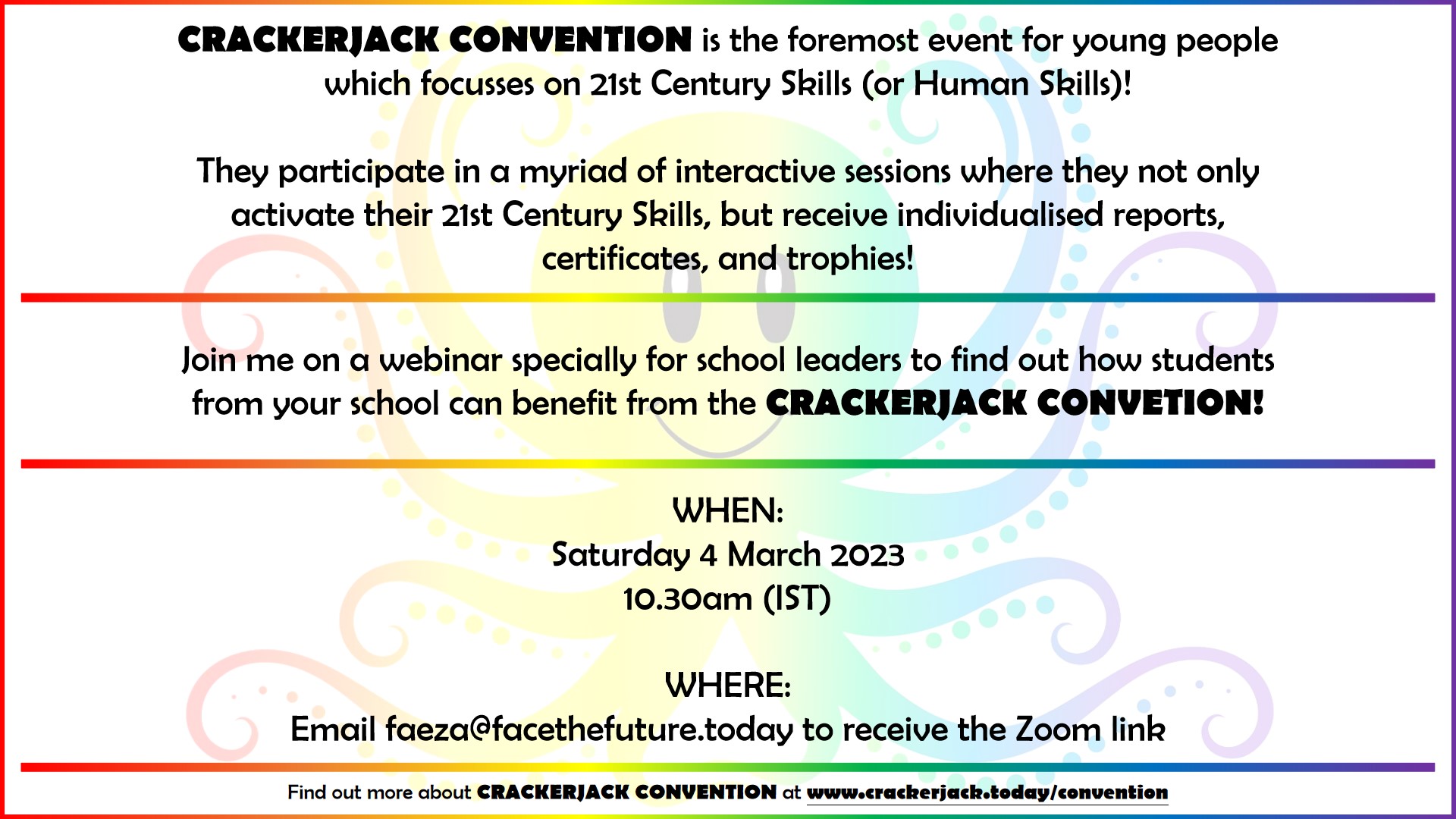
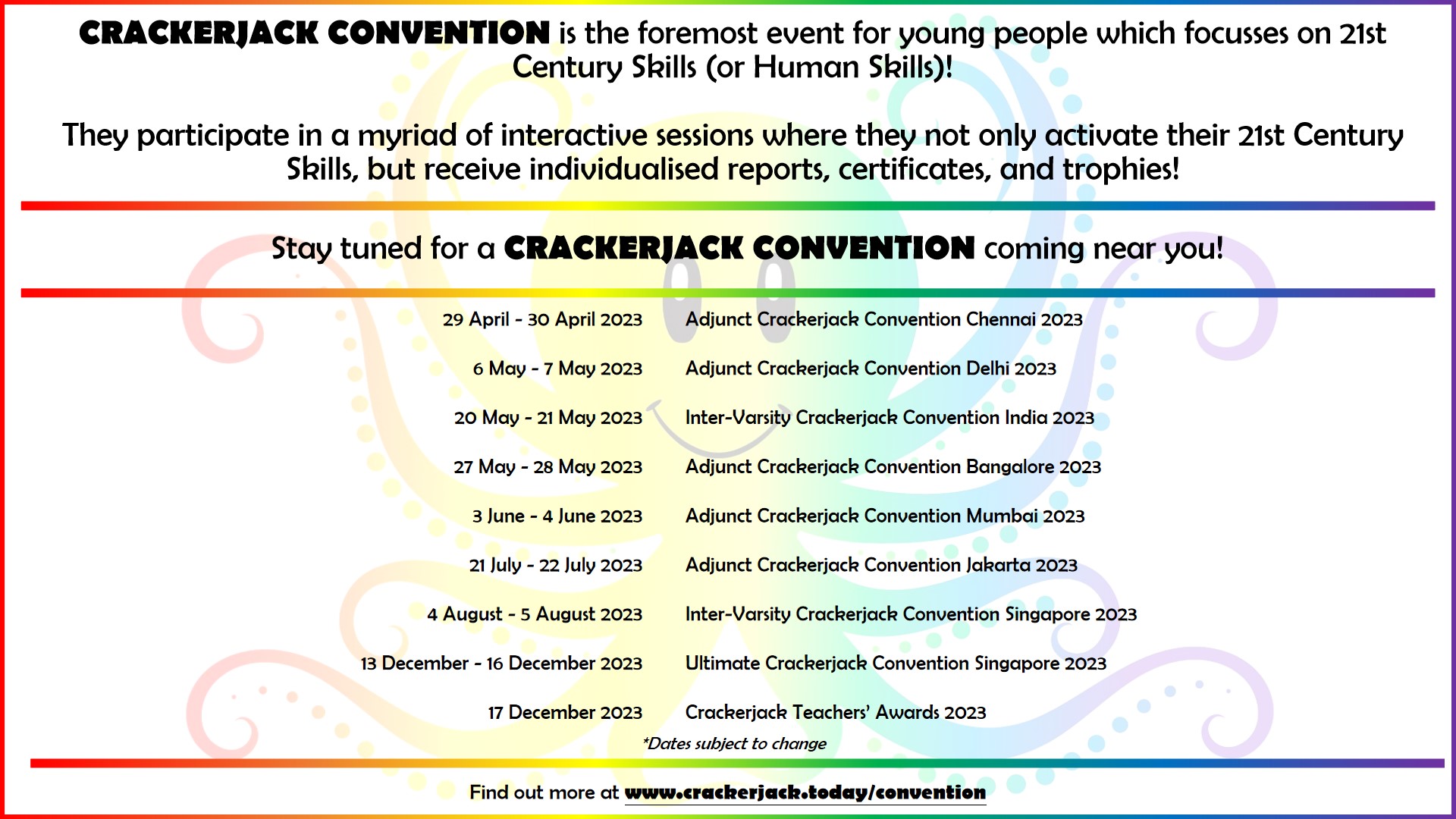
Fuzzie, a former educator, runs an annual event called the CRACKERJACK CONVENTION, where young people interact in fun tasks to activate and get evaluated on their 21st Century Skills, like Critical Thinking.
Showcase of the week
And Finally…

This newsletter is supported by the following:


 Nivedita Mukerjee