Nivedita Mukerjee
Education consultancy for parents and schools
3-2-1 TUESDAYS WITH MS NIV
Issue #232, 17th December 2024
Students are frequently categorized based on perceived intellectual/Behavioral/Personality abilities, and get labelled by teachers and/or parents as:
- “Gifted” or “Advanced” for children who demonstrate high academic performance or exceptional cognitive skills
- “Learning Disabled” or “Special Needs” for children who struggle academically or have diagnosed learning differences
- “Average” or “Standard” for students who perform at grade-level expectations Behavioral Labels Children are often characterized by their observable behaviors and social interactions:
- “Troublemaker” or “Disruptive” for students who challenge classroom rules or have difficulty following instructions
- “Quiet” or “Shy” for children who are less socially assertive or prefer solitary activities
- “High Energy” or “Active” for students who have difficulty sitting still or maintaining focused attention
- “Sensitive” for children who experience emotions intensely or are easily overwhelmed
- “Type A” or “Perfectionist” for students who are highly driven and self-critical
- “Easy-going” or “Laid-back” for children who adapt quickly and seem less stressed
While these labels might seem descriptive, they can be potentially harmful!
Such categorizations can:
- Limit a child’s perception of their own potential
- Create self-fulfilling prophecies
- Reduce the complexity of a child’s personality and capabilities to simplistic descriptions
Experts recommend focusing on specific behaviors, abilities, and growth potential rather than broad, potentially restrictive labels. Here are some thoughts and suggestions for you to consider.
This is a free newsletter. If you like my content, please subscribe by entering your email ID here.
Three images of the week



Two Thoughts of the Week
“Tell me and I forget, teach me and I may remember, involve me and I learn.” — Benjamin Franklin
“If you learn from defeat, you haven’t really lost.” — Zig Ziglar
One Video of the Week
When Ava Echard was 5 years old, she took a test that placed her in a gifted and talented program. Participating in this program offered Ava many exciting opportunities, but it also made her wonder: what made her so “special,” and why was this specialness determined at such an early age? Now in high school, Ava’s questioning whether her “gifted and talented” label had more to do with her advantageous upbringing than with her innate abilities. In this comprehensive Talk, Ava explains why schools should consider the relationship between nature and nurture, and focus more on celebrating the many different kinds of intelligence that exist among students.
Reading with Ms. Meenu: Tip of the week
Practice Reading with Short Text:
Once in a while, students will get sidetracked when they decide the text is boring. As a literacy teacher we should catch this at an early stage. The main idea is for students to choose an interesting book and have thoughtful peer-led conversations about them. Sometimes these topics and conversations can be boring. And teachers often (and rightfully) worry: What if the kids don’t remember enough to sustain enough knowledge. What if I send my students off to their book clubs and they sit there staring at each other with nothing to say? Yikes – as an educator we can’t have that! We need kids to be engaged at their reading/discussions with plenty to talk about. We should teach students a repertoire of strategies for captivating and recording the following:
Ø Feelings
Ø Visualizations
Ø Connections
Ø Predictions
Ø Questions
Ø Judgements
Ø Inferences
Ø Responses
Have your students try to read:
Ø A section from a novel
Ø A short-short story
Ø A graph or chart
Ø A poem
Ø A news article
Ø A selection from a trade non-fiction book
Some of us can be part of effective discussants without any written notes, while others need something tangible to refer to. So, it’s a good idea to respect different learning and thinking styles as long as we are mentoring them in the right direction.
Happy Reading!
Meenu Gera
Consulting home and school librarian and reading guide.
Career assessment, guidance, and placement strategies:
From Engineering Aspirations to Business Analytics: A Path Realigned
Vinay chose physics, chemistry, Economics, and mathematics in grade 11 to prepare for the JEE exam and pursue engineering at the undergraduate level. While the choice of subjects was his decision, at the beginning of Grade 12, he started expressing disinterest in engineering and showed a preference for a BBA. He wanted to follow in his elder brother’s footsteps who had completed a BBA from Christ University Bangalore and later was pursuing an MBA in the US. Vinay was certain that preparing for and completing an engineering degree would be a waste of time, as he did not envision building a career in this field. He was unreceptive to any suggestions from his parents. The parents approached us and the career counseling session was scheduled.
In a detailed discussion, the career expert discovered that Vinay was falling behind in his coaching classes, leading to a decline in his performance. This demotivated him further and caused him to lose complete interest in engineering. Additionally, he developed a fear of taking the JEE entrance exam, making the situation even more worrisome.
To address this, the career expert adopted a bridge approach, exploring undergraduate programs in Business Analytics that aligned with Vinay’s science background. He was receptive to a few suggestions and agreed to consider alternate undergraduate programs that would help him develop the right skills and ensure employability immediately after graduating.
To address this, the career expert adopted a bridge approach, exploring undergraduate programs in Business Analytics that aligned with Vinay’s science background. He was receptive to a few suggestions and agreed to consider alternative undergraduate programs that would help him develop the right skills and ensure employability immediately after graduation.
Case study provided by: Team Fermata, www.fermataco.com
And Finally:

Showcase of the week:
Project Based Learning: Thrive – Beyond School; A STEAM program for preschool and primary school students, Hyderabad.
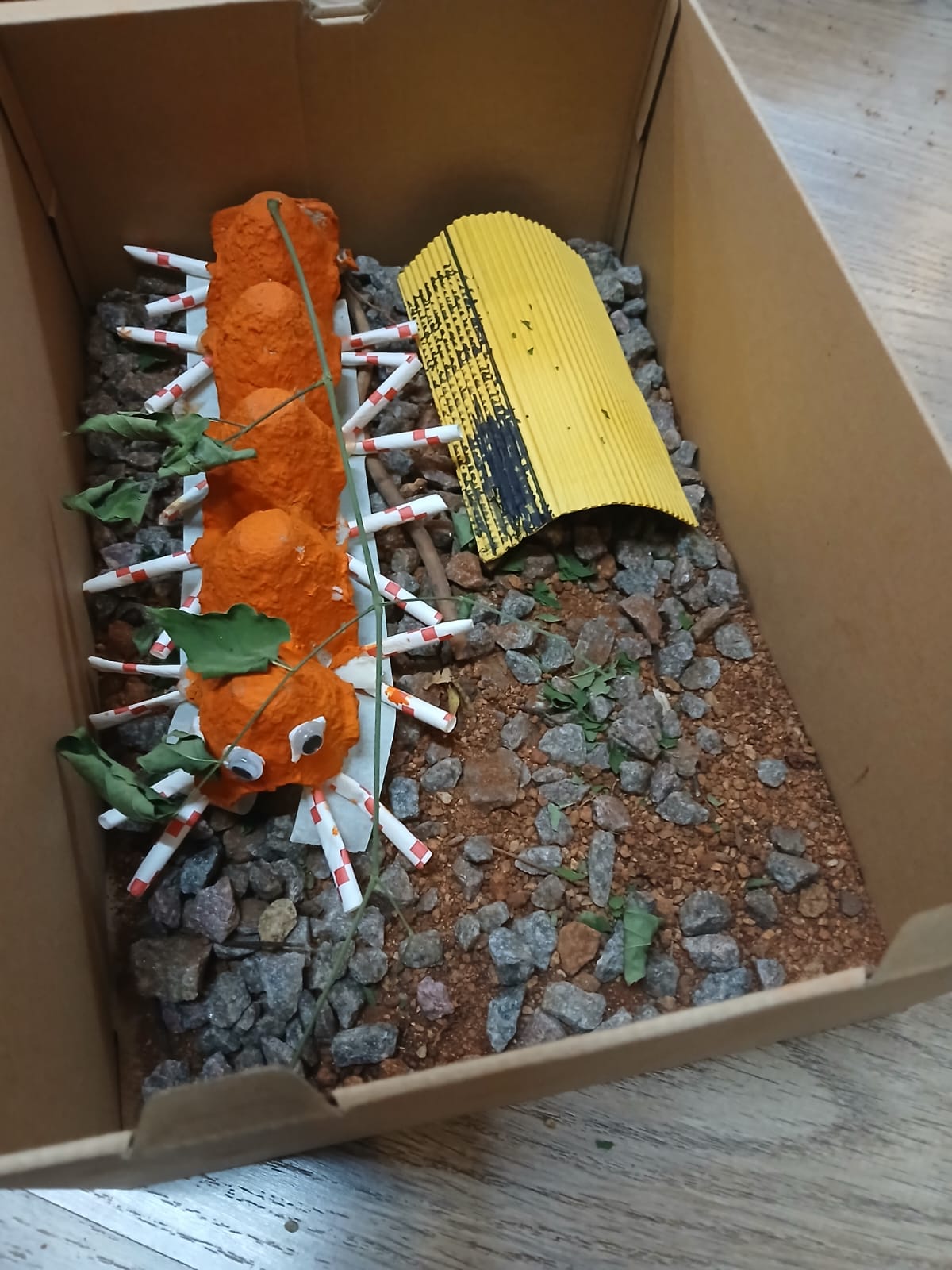
Through the millipede habitat art project, the children learned about the natural environment of millipedes, including the need for damp, dark spaces with decaying leaves and soil. They also gained practical experience in using recycled and natural materials to create an appropriate habitat, understanding how various elements contribute to the millipede’s survival.
Neev ,Mayra,Samyuktha, Tashvika& Havishka
6.5 years old; Tara & Arnav 5.5 years old
Capstone High School, Hoskote, Bangalore: For our recent art project with grade 2, I introduced students to geometric abstract portrait art, inspired by cubism. I showed them examples of geometric abstract cubism portraits and shared how artists like Picasso approached art with unique perspectives, encouraging them to think differently about portrait creation. Through this project, students learned to experiment with shapes and forms to create their own unique portraits. This activity fosters early creative thinking and helps young learners explore self-expression in art, encouraging them to develop a personal style within a guided framework of geometric abstraction.
Dear reader,
I work with the school leadership team as an advisor. I collaborate with teachers as a pedagogical trainer. I help parents as a parenting counselor. I engage one-on-one with students as a personal guide and mentor. This weekly newsletter shares what I read, learn, and experience.
3-2-1 Tuesdays with Ms. Niv is a newsletter you can subscribe to and enjoy your learning journey with me.
From the archives
Many of you have been asking for the earlier editions of this newsletter. I am delighted to note that you are enjoying the content served here. Now, with every new issue, I share a link to the newsletter from the archives. These have been published weekly since July 2016.
Here is the link for – issue#008
https://wordpress.com/post/niveditamukerjee.com/3040
Enjoy your learning journey with me.
 Nivedita Mukerjee