Nivedita Mukerjee
Education consultancy for parents and schools
3-2-1 Tuesdays with Ms Niv

Issue #263, 22nd July 2025
“Am I solving the problem I think I should solve, or the problem I actually need to solve?”
When you find yourself giving answers like “that’s not how it’s done,” “people like me don’t do that,” or “that would never work,” you’re likely bumping against the walls of your current box. The barriers you’re breaking are often mental ones that existed long before any external obstacles appeared.
So what are the barriers you are breaking for yourself and for your child/student as a parent/educator?
This is a free newsletter. If you like my content, please subscribe by entering your email address here.
Three Images of the Week


Two Thoughts of the Week
“The rooms to explore are not limited only to the ones on planet earth. Don’t be afraid to also explore the spaces above, below, within, and beyond.”
― Mitta Xinindlu
“Traditions are just peer pressure from dead people.”
― Eliot Schrefer
One Video of the Week
What can’t Candace Parker do? A two-time NCAA champion, two-time Olympic gold medalist and two-time WNBA champion, Parker knows what it takes to fight for your dreams. In this inspiring talk, she shares what she’s learned during a career spent not accepting limits — and how her daughter taught her the best lesson of all. “Barrier breaking is about not staying in your lane and not being something that the world expects you to be,” she says. “It’s about not accepting limitations.”
Reading with Ms. Meenu: Tip of the week
Let’s discuss the third lever for Literacy.
Teaching: As educators or even as parents we need to teach reading, not just model it, because (unlike with spoken language) most kids don’t learn to read well without intentional, direct instruction – which many of us are ill-equipped to do so. A lot of times we do see low reading achievement scores among our students and to solve that problem is more gradual and integrated than typical reading instructions. We know that our students have to learn words, so we all get a list of words or stare at them and ask them to memorize these words. A better approach would be to give them multifaceted experience with same word family spellings, pronunciation and meaning. It takes knowledge of all three (preferably in contexts kids care about, like conversation, books they’re reading, even shows they are watching) to make a word stick in memory.
Effectiveness comes with matching the lesson with these words to the child and the moment. Even pull-out vocabulary words on the topic your students are learning in class. This would be helpful to understand the topic and they can relate to it. Depending on their age, stage and interests you could be teaching through song or play, reading or writing or talking and listening.
When teaching, give your students a preview of the insight you’re about to share, so they know what to look and listen for, talk out your thought process step by step and then sum up your point.
The teaching of reading is too important, so let’s learn ourselves and pass it on to our students.
Meenu Gera
Consulting home and school librarian reading guide
Career assessment, guidance, and placement strategies:
Careers in Science, Tech, Engineering & Mathematics
Individuals in these professions engage in scientific exploration and research, working in both laboratory and outdoor environments. They take on roles as scientists, mathematicians, technologists, and engineers, with some focusing on testing and support services. Possible career paths within this field include Engineering, Physical Sciences, Natural Sciences, Mathematics, and Health, Safety, and Environmental Management.
| Astronomer | Atmospheric & Space Scientist | Physicist |
| Aerospace Engineer | Architectural & Engineering Manager | Electrical Engineer |
| Computer Hardware Engineer | Electronics Engineer | Energy Engineer |
| Fire-Prevention and Protection Engineer | Fuel Cell Engineer | Health & Safety Engineer |
| Industrial Engineer | Manufacturing Engineer | Marine Engineer |
| Material Engineer | Chemical Engineer | Mechanical Engineer |
| Microsystems Engineer | Automotive Engineer | Geological Engineer |
| Nanosystems Engineer | Nuclear Engineer | Photonics Engineer |
| Quality Control Analyst | Robotics Engineer | Solar Energy Systems Engineer |
| Environmental Economist | Environment Restoration Planner | Environment Scientist & Specialist |
| Mathematician | Biostatistician | Remote Sensing Technologist |
| Statistician | Ergonomist | Geographer |
| Economist | Industrial Ecologist | Precision Agriculture Technician |
| Cartographers & Photogrammetrist | Climate Change Policy Analyst | Conservation Scientist |
| Anthropologists & Archaeologist | Geoscientist | Hydrologist |
| Biofuels Technology & Product Development Managers | Clinical Data Manager | Molecular & Cellular Biologist |
| Biochemist & Biophysicist | Biologist | Geneticist |
| Microbiologist | Chemist | Material Scientist |
| Bioinformatics Scientist | Zoologist & Wildlife Biologist | Park naturalist |
Fermata Career Solutions inspires young individuals aged 13 to 30 to unlock their potential through focused and customised career and college counseling. With expertise in University Readiness, CareerGym, and Master Parenting, the experts empower you to pursue your dreams and shape your future with confidence. More about us on www.fermataco.com
Showcase: Thrive Beyond School – A unique STEAM education project for very young learners.
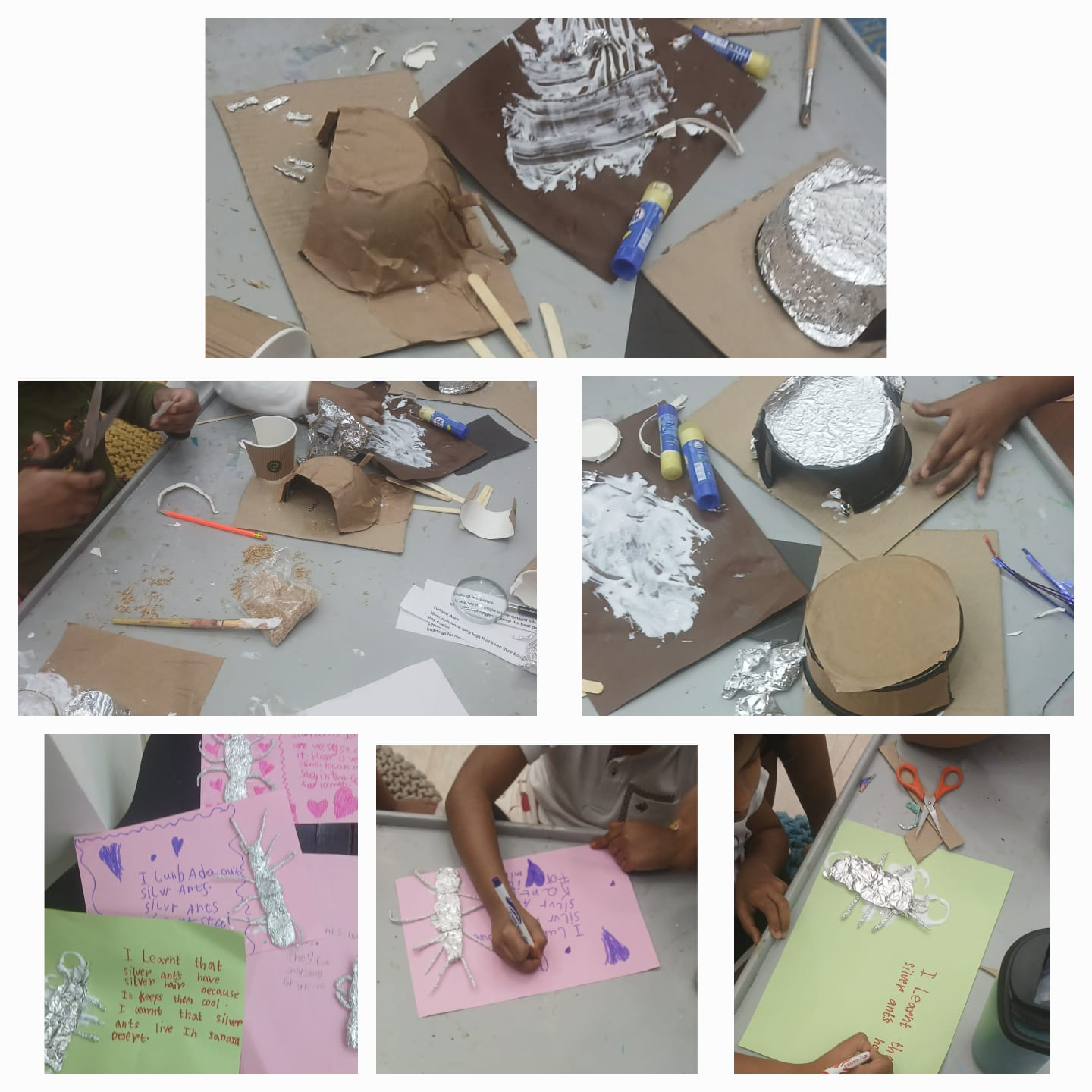
The children explored how animals adapt to survive in extreme environments, focusing on the fascinating case of the silver ant. Through the story of Sammy the Silver Ant, they learned that his shiny silver coat helps him reflect sunlight and stay cool in the hot desert. To understand this adaptation better, the teacher led an engaging activity using black paper, white paper, and foil under a lamp. The children used their hands to feel the heat difference and magnifying glasses to observe the surface textures. They discovered that black paper absorbs more heat and gets hotter, while shiny and white surfaces reflect sunlight and stay cooler. To apply this understanding, the children built mini shelters for Sammy using recycled materials such as white and brown paper and a foil roof.
This helped them explore how reflective materials can keep things cool just like Sammy’s coat. During the group reflection, Samyuktha (7 years 3 months), Tashi, Neev, and Mayra (6 years 11 months), and Tara (5 years 9 months) shared.
Dear reader,
I work with the school leadership team as an advisor and collaborate with teachers as a pedagogical trainer. I also help parents as a parenting counselor and regularly engage one-on-one with students as a personal guide and mentor. This weekly newsletter shares what I read, learn, and experience.
3-2-1 Tuesdays with Ms. Niv is a newsletter you can subscribe to and enjoy your learning journey with me.
 Nivedita Mukerjee