Nivedita Mukerjee
Education consultancy for parents and schools
3-2-1 Tuesdays with Ms Niv

Issue #271, 16th September 2025
In our information-rich world, students need explicit instruction in evaluating sources, identifying bias, and distinguishing between correlation and causation. This means practicing with real examples: comparing news articles on the same event from different sources, analyzing advertisements for persuasion techniques, or examining scientific studies to understand how conclusions are drawn
Rather than simply providing answers, demonstrate the thinking process by asking follow-up questions like “What makes you think that?” or “How did you reach that conclusion?” When you encounter new information, verbalize your own questioning: “I wonder if this source is reliable” or “What evidence supports this claim?” Students learn more from observing authentic intellectual curiosity than from being told to “think critically.”
This is a free newsletter. If you like my content, please subscribe by entering your email address here.
Three Images of the Week


Two Thoughts of the Week
“It is not the strongest of the species that survive, nor the most intelligent, but the one most responsive to change.” Charles Darwin
“The measure of intelligence is the ability to change.” Albert Einstein
One Video of the Week
Eddy Zhong, successful technology entrepreneur, dives into the truth behind our K-12 education system. Eddy strongly believes that the education system diminishes creativity and confines children to a certain path towards success.
He contends that kids are taught to believe college is a necessary step in life and that it is mandatory to achieve one’s goals. His talk challenges the commonly held beliefs of our entire education structure. Eddy is the founder of Leangap, a summer program that helps high school students start their own companies Eddy is an aspiring technology entrepreneur and the founder of Blanc, a smart-watch company based in Cambridge, Massachusetts.
His ideas have been featured in numerous publications and he is passionate about empowering youth to think differently. Eddy is the founder of Leangap, a summer program that helps high school students start their own companies
Reading with Ms. Meenu: Tip of the week
Writing and Noticing Print from 3 to 4 years
By age 3, kids typically know the names of family members, friends, and most objects in their daily lives. They understand prepositions (on, in, under) and can string two or three sentences together. They know many words and their opposites. They push and pull toy vehicles to get them moving. They can put things like – colors, shapes, toys and objects and count real-life objects like books on a table.
Their attention to and interest in longer stories takes off and they can show off their comprehension by answering questions about what they just heard. They can follow a clear storyline from beginning to middle to end. You can now ask questions during read-aloud that prompt them to think more, make predictions about what will come next, and connect stories to their own experiences.
You’ll want to stick more closely to the text as printed on the page now, too, if you were prone to freestyling or skipping passages to keep their interest. Making print to speech connections is on their horizon now.
Talk about the lines, curves, hooks, humps, and dots that form letters. This helps kids understand that a limited number of critical features form all letters.
Book Behaviour, Print Awareness, Writing and Letter Recognition:
· Follow the structure of a story
· Makes predictions about what will happen next in a tale
· Connects text to personal experience
· Points to print as the source of information in a story
· Recognizes and prefers favorite book characters
· Understands that pictures are connected in a story
· Recognizes their own name in print, plus some familiar words
· Names letters on everyday objects, signs and posters
· Makes letter-like scribbles to represent words
· Attempts to print their own name
Happy Reading!
- Meenu Gera, Consulting home and school librarian reading guide
Career assessment, guidance, and placement strategies:
Get ready for your dream university: What New York University Looks For
New York University (NYU) was founded in 1831 to create a new kind of higher education institution that broke from the elitist traditions of early 19th-century American colleges. The founder’s Albert Gallatin, former U.S. Secretary of the Treasury under Presidents Jefferson and Madison, believed America needed a university that was practical, inclusive, and connected to the realities of urban and commercial life. Gallatin and a group of prominent New Yorkers wanted a school that reflected the city’s energy, diversity, and growing economy. Today, NYU is recognized as a global, research-driven, creative university with campuses in New York, Abu Dhabi, and Shanghai.
What does NYU look for in students? Here’s how you can identify a strong fit:
- Challenging coursework
- Strong performance in subject areas related to the intended major
- Evidence of cross-disciplinary curiosity
- Volunteering, internships, or projects in busy city environments
- Published writing, coding projects, and entrepreneurial ventures
- Adaptability and resourcefulness in new settings
- Community problem-solving
- Internships in industry hubs
- Cross-cultural leadership
In a nutshell, NYU values students who make things happen – those who use resources, build connections, and create impact both inside and outside the classroom.
Fermata Career Solutions inspires young individuals aged 13 to 30 to unlock their potential through focused and customised career and college counseling. With expertise in University Readiness, CareerGym, and Master Parenting, the experts empower you to pursue your dreams and shape your future with confidence. More about us on http://www.fermata.com
I Think, I Wonder, I Ask
Small Steps Towards Big Learning

When we aim to build a culture of collaboration and peer coaching in academics, our minds immediately turn to higher- order tasks- critical thinking, problem solving, and in-depth analysis. But are students truly ready to leap into these spaces without first practicing the art of collaboration in simpler, more accessible ways? Sometimes, the entry point to higher-order collaboration is not in academics at all, but in everyday school experiences.
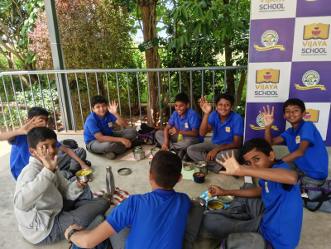
I was reminded of this during the recent inter-grade sports matches. High school captains coached younger students, guiding them not only on techniques but also on teamwork and sportsmanship. On the surface, it was play, beneath it was practice. Students were learning to give feedback, accept corrections and adjust strategies- exactly the skills we later expect in academic peer reviews or group projects.
This foundational practice shows up in everyday school life. Picnic lunches, where children sit together and share food, become spaces for perspective- taking. Student- led events serve as rehearsals for decision-making, negotiations, and responsibility. Even simple collaborative classroom responsibilities like arranging books, organizing bulletin boards, may seem routine, yet they cultivate habits of cooperation and shared accountability.
These practices may seem ordinary, but they are powerful examples of Vygotsky’s zone of proximal development: low-stakes, scaffolded opportunities where learners stretch just beyond their comfort zones, supported by peers. Such “low- hanging” practices are not merely warm-ups- these are essential foundations for higher- order, critical tasks.
Three questions for you…
What would shift in the classrooms if we treated peer-led, low stakes practices as essential rehearsals, as seriously as we treat academic practices?
How can we make students’ collaborative learning visible and celebrate small wins so they recognize progress, not just grades?
Are we patient enough to let small, scaffolded experiences take root and grow into lasting capacities before demanding advanced cognitive work?
Dr Shreelakshmi Subbaswami, Alumni and Academic Director, Vijaya School Hassan, Karnataka
Showcase: Thrive Beyond School – A unique STEAM education project for very young learners.
The children explored how dinosaurs lived in different habitats by first observing images of deserts, jungles, and coastal areas from the Mesozoic Era. They discussed how animals needed the right climate to survive, making connections to examples like polar bears in the Arctic and camels in deserts. Each child then created their own mini dinosaur terrarium using soil, sand, rocks, plants, and toy dinosaurs to represent habitats such as hot deserts, wet jungles, and coastal areas. With the help of heat lamps and spray bottles, they investigated how temperature and humidity affected these environments, measuring and recording their findings with gauges.
Samyuktha & Havishka: 7 years 5 months old
Tashi & Mayra: 7 years old

Dinosaur DNA Extraction Simulation
The activity began with a thought-provoking question: “What makes you different from your friends?” The children shared meaningful responses—Neev said “our likes,” Mayra said “identity,” Samyuktha said “dislikes,” Tashi said “feelings,” and Havishka said “different names.” When asked, “Why do you have your hair, your smile, or your favorite taste?” Mayra thoughtfully replied, “we all are different and we all like different things.”
Before introducing the concept of DNA, the teacher asked if the children had heard of it before. Mayra explained that it is “something inside our body that helps us to do something,” while Havishka described it as “a special password in our body,” giving the example that even a strand of hair could reveal that password if tested.
During the banana DNA extraction, the children learned that DNA is like a special recipe or instruction book inside every living thing, guiding growth and traits. Through the experiment, they discovered how soap breaks open cells, salt helps the DNA clump together, and alcohol makes it visible. By mashing the banana, filtering the mixture, and carefully adding chilled rubbing alcohol, they observed white, stringy, cloudy material rising into the alcohol layer this was the banana’s DNA.
Samyuktha & Havishka: 7 years 5 months old
Tashi, Neev & Mayra: 7 years old

Pooja Khatter, facilitator, Thrive
Dear reader,
I work with the school leadership team as an advisor and collaborate with teachers as a pedagogical trainer. I also help parents as a parenting counselor and regularly engage one-on-one with students as a personal guide and mentor. This weekly newsletter shares what I read, learn, and experience.
3-2-1 Tuesdays with Ms. Niv is a newsletter you can subscribe to and enjoy your learning journey with me.
 Nivedita Mukerjee