Nivedita Mukerjee
Education consultancy for parents and schools
3-2-1 Tuesdays with Ms Niv

Issue #278, 28th October 2025
You missed this.
You did this wrong.
You got this much out of this much as score.
Your performance could be better.
OR This is what you missed, this is what could be possible responses, this is how you can improve your score, tell me how you can improve your performance next time.
Think about your feedback as a parent/educator and what it does to your child’s/student’s agency and ownership of their learning and/or behaviour.
This is a free newsletter. If you like my content, please subscribe by entering your email address here.
Three Images of the Week


Two Thoughts of the Week
“Tell me and I forget. Teach me and I remember. Involve me and I learn.” – Benjamin Franklin
“Student agency is that energy that students get when they take charge of their learning and hold themselves responsible for their accomplishments.― Kelly a Flores, Supporting the Success of Adult and Online Students: Proven Practices in Higher Education
One Video of the Week
Building Student Identity and Agency Dr. Dominique Smith is the Chief of Educational Services and Teacher Relations at Health Sciences High and Middle College (HSHMC) located in San Diego, CA. Dr. Smith has helped transform HSHMC to become a restorative school with his efforts in building relationships with students and hearing student voice. His focuses on school wide mind shifts to restorative practices and school equity have taken him across the world to help schools make change.
Dr. Smith has published books with authors Douglas Fisher and Nancy Frey, “Better than Carrots and Sticks” and “Building Equity, Policies and Practices to Empower All Learners,” and “Engagement by Design”.
Reading with Ms. Meenu: Tip of the week
Oral Language:
Oral Language is one of the pillars to get strong reading skills.
Spoken words are the precursor of all precursors to reading. When learning to read, a child can’t make sense of a word in print that they haven’t heard before in life. So parents must carry on conversations from the beginning to build up their kid’s word banks. Research provides evidence that the better children’s vocabularies at kindergarten entry, the better their reading comprehension in third grade, and the better their third grade reading skills, the better their high school graduation rates. Whatever your child’s age, they’ll benefit from more conversation with you.
For optimal brain development, aim for 40 conversational turns per hour when you’re with your little one. It counts as a turn whenever you greet one of your baby’s coos, babbles, words or sentences with a verbal response (or they verbally respond to your words) within 5 seconds. It’s tough to get an exact count, of course, without feedback from a “talk pedometer” like those used by researchers. Just know that most parents speak a lot less than they should and a lot less than they think they do. The lesson here is give your child the best shot at better vocabulary by taking every conversational turn you can.
The central truth every parent must grasp is this: Oral language skills are required for reading. Just as kids crawl before they walk, they talk before they read. And before they talk, babies listen, grunt and coo. We must facilitate and encourage it all.
We talk to our kids for all kinds of reasons in the moment to soothe, to encourage, to entertain, to direct. And there’s power in every word we speak, including the impromptu conversations we have while giving baths, making meals, and playing at home. Delivering a kind of fortified talk that’s extra nourishing to their long term brain, language and social development.
Happy Reading!
Meenu Gera, Consulting home and school librarian, reading guide
I Think, I Wonder, I Ask
–Dr Shreelakshmi Subbaswami, Academic Head, Vijaya School Hassan, Karnataka
Student Agency through a Cultural Lens
If student agency — voice, choice, and ownership is vital for meaningful learning, then understanding it through a cultural lens becomes essential.
We often notice in classrooms that reverence for authority is seen as a virtue. When a student questions an idea, it is often dismissed as over smart or irrelevant. When a learner seeks choice, it is mistaken for entitlement. Respect for teachers, elders, and systems is deeply woven into our social fabric. Yet, somewhere along the way, respect has blurred into compliance, and curiosity began to be perceived as disobedience.
In my discussions with school leaders and researchers around the world, many have shared that bringing student agency into schools is challenging in contexts where the macro-culture rewards obedience, conformity, and discourages questioning. The challenge deepens because teachers themselves emerge from the same cultural background, carrying inherited beliefs about respect, discipline, and hierarchy into their classrooms.
Thus, the macro culture interacts constantly with the micro culture of schools. Together, they determine whether student agency is nourished or neglected.
I believe being cognizant of this interplay is the first step towards change. To move forward, we must make peace with discomfort. Reimagining student agency demands not reform alone, but courage, humility, and continuous dialogue.
Three Questions for You
How can schools align family, community, and classroom practices to create a culture where agency is shared and sustained?
In what tangible ways — through physical spaces, materials, or classroom arrangements — does school reflect or restrict student voice and participation?
In what intangible ways — through language, traditions, expectations, or teacher–student interactions — does your culture nurture or silence agency?
Showcase: Thrive Beyond School – A unique STEAM education project for very young learners.
– Pooja Khatter, facilitator, Thrive
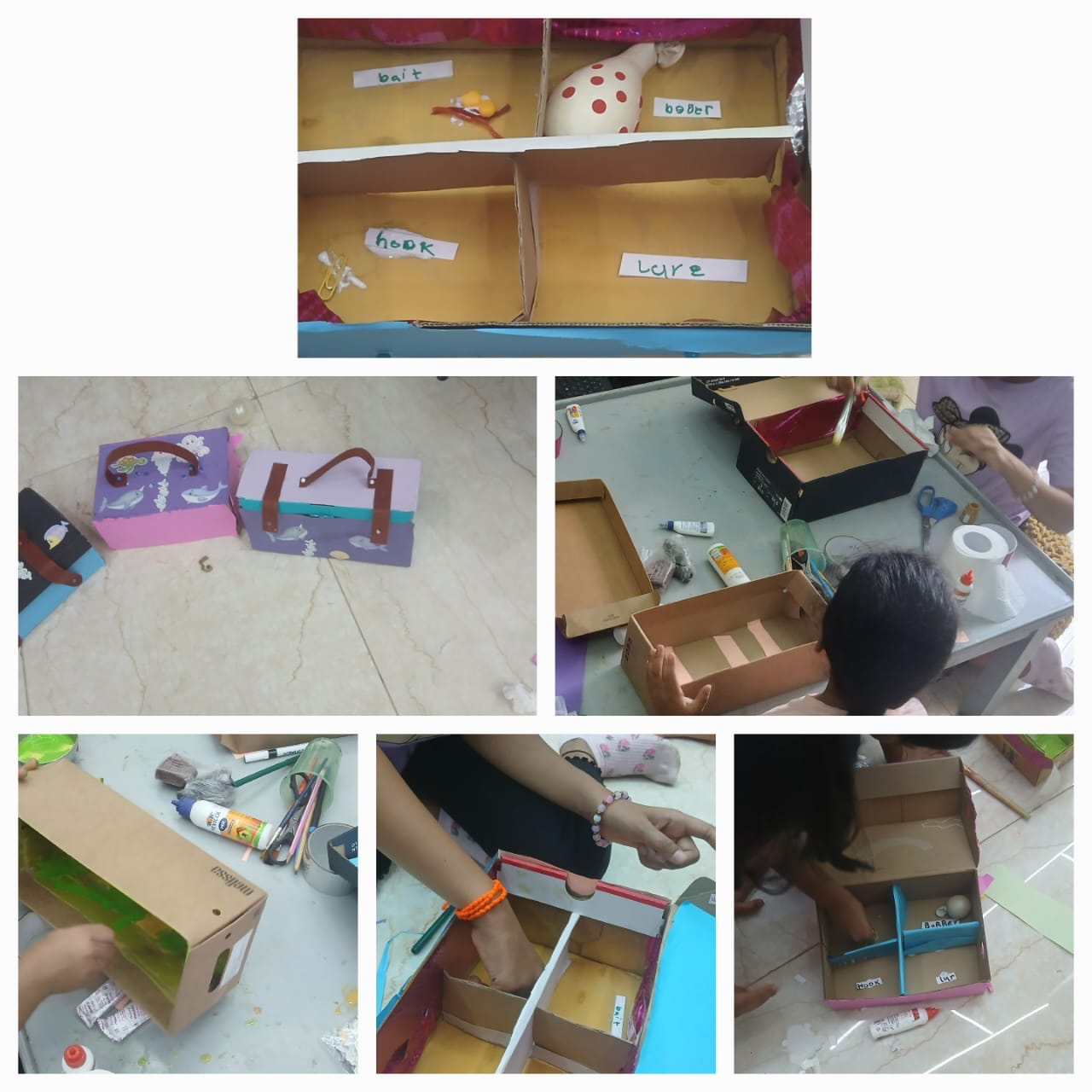
The children learned that a tackle box helps keep fishing tools safe and organized. Working in pairs or on their own, they decorated their own tackle boxes using recycled materials. They used cartons, paints, color sheets, stickers, and strips to create compartments for items like bait, lures, bobbers, and hooks.
This hands-on project encouraged planning, sorting, labeling, and spatial thinking, helping children think like real engineers while having fun organizing their gear. Samyuktha & Havishka : 7 years 2 months old Tashi :7 years old. Tara : 6 years 11 months old
Dear reader,
I work with the school leadership team as an advisor and collaborate with teachers as a pedagogical trainer. I also help parents as a parenting counselor and regularly engage one-on-one with students as a personal guide and mentor. This weekly newsletter shares what I read, learn, and experience.
3-2-1 Tuesdays with Ms. Niv is a newsletter you can subscribe to and enjoy your learning journey with me.
 Nivedita Mukerjee