Nivedita Mukerjee
Education consultancy for parents and schools
3-2-1 Tuesdays with Ms. Niv

Issue #299, 24th March 2026
Learning is unlimited. Even the things one is interested in are unlimited if we drop all the things one is uninterested in. Then why is it considered boring by most? What is teaching? What is an informative speech? What can make lifelong learning come naturally? Why do I start my newsletters with questions?
This is a free newsletter for parents, educators, and students. If you like my content, please subscribe by entering your email address here.
Three Images of the Week
Two Thoughts of the Week
“If nobody asked questions, then we would never learn anything.”
― Brandon Sanderson, Oathbringer
“Change the questions you ask, the way you view the issue will be transformed and innovation will start!”
― Isaac You
One Video of the Week
Why do we ask questions? Michael “Vsauce” Stevens at TEDxVienna. Michael Stevens the persona behind the YouTube sensation Vsauce, is an online personality with an entertaining approach to explaining the science behind seemingly ordinary, everyday phenomena.
Reading with Ms. Meenu: Tip of the week
Digital Literacies in Today’s World
Digital literacy is no longer an optional skill. It is important for learning, working, communicating, and participating fully in modern society. In the past, literacy often meant the ability to read and write printed text. Today, it also includes the ability to understand, evaluate, create, and share information through digital tools and online platforms. Digital literacies help people move from simply using technology to using it thoughtfully, safely, and effectively.
At its core, digital literacy is about more than knowing how to operate a device. Kids do know how to open an app, search online, or send a message, but true digital literacy involves asking deeper questions from students:
- Is this information reliable?
- Who created it, and why?
- Is it safe to click this link or share this content?
- How should one communicate respectfully and responsibly in online spaces?
These questions show that digital literacies combine technical ability with critical thinking and ethical awareness.
A key component of digital literacy is information literacy. Although the internet provides endless access to information, not all of it is reliable or accurate. Educators should help learners develop the ability to compare sources, detect bias, identify misinformation, and fact-check content before believing or sharing it. This is particularly important for students, who often depend on online sources for academic work. High school students should also be taught how to cite sources properly and understand the consequences of plagiarism, since ethical use of information is an essential part of digital literacy.
Digital literacies are especially important in education. Students must not only consume online information but also learn how to question it, organize it, and use it responsibly. Teachers and librarians play a major role in guiding this process. They help learners develop safe online habits, research skills, and confidence with digital tools. In schools and libraries, digital literacies can promote equity by helping all learners, regardless of background, gain access to the skills needed for the future.
Communication is also central to digital literacies. People now interact through email, video calls, online classrooms, messaging apps, and social platforms. Each space requires different tones, behaviours, and expectations. Digital literacy includes knowing how to communicate clearly, professionally, and respectfully in these environments. It also includes understanding digital citizenship: using technology in ways that are responsible, kind, legal, and inclusive.
Creativity is another valuable part of digital literacies. Digital tools allow people to create presentations, podcasts, videos, blogs, websites, and graphic designs. These forms of expression help learners and professionals share ideas in engaging ways. When individuals know how to use digital tools creatively, they are better able to tell stories, solve problems, and contribute meaningfully to their communities.
At the same time, digital literacies are closely connected to issues of access and inclusion. Not everyone has the same access to devices, internet connections, or quality digital instruction. For this reason, digital literacy education must be intentional and inclusive. It should support children, youth, adults, and seniors, recognizing that different groups have different needs and starting points. Teaching digital literacies is not only about technology; it is about opportunity, participation, and empowerment.
In conclusion, digital literacies are essential life skills in the twenty-first century. They help individuals navigate information, communicate responsibly, create confidently, and participate actively in digital society. As technology continues to shape everyday life, developing digital literacies becomes a powerful way to support learning, independence, and informed citizenship. A digitally literate person is not simply someone who can use technology, but someone who can use it wisely.
Happy Reading!
– Meenu Gera Consulting home and school librarian, a reading guide
I Think, I Wonder, I Ask
–Dr. Shreelakshmi Subbaswami, Academic Director, Vijaya School, Hassan, Karnataka
In most schools, the curriculum, the scope and sequence of a subject are rarely questioned. We inherit it—from textbooks, boards, and prescribed structure and proceed to deliver it. Such systems reduce schools to mere implementers of the curriculum, rather than co-creators who respond to the needs, context of learners, and the vision of the school.
When curriculum is dictated from the top about what content to teach, how to teach, in what order and which perspectives to include, it leaves little room for schools to respond to their learners and their own vision. Content becomes decontextualized, at times outdated, and excludes diverse perspectives.
This year, we chose to ask: What are we really teaching, and why? We began small—one grade, one subject—but with intent. Not to reject structure, but to regain purpose.
We anchored our work in four considerations:
- The Learner: Is this meaningful for the child, at this stage?
- Society: Does it reflect the realities, values, and aspirations of the community?
- Knowledge: Are we choosing what truly matters, and structuring it meaningfully?
- The Teacher: Is the teacher a facilitator of learning or just a deliverer of content?
We reviewed national and international standards, but more importantly, we invited teachers into the process—not as implementers, but as co-creators. They helped gauge what is just right and what is possible.
I believe the curriculum is not a fixed document- it is a lived experience. And unless schools take agency, learning becomes distant, disconnected, and reduced to completion rather than understanding.
Three questions for you…
- What courage does it take for a school to design its own path?
- Whose context does our curriculum represent?
- What would we remove if we truly prioritized learning over coverage?
From the Principal’s Desk
– Suchismita Ray Gupta, Head of School, Capstone High, Hoskote, Karnataka
Magic of Questions
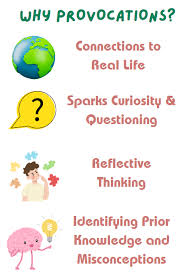
Schools traditionally ask questions just to check recall, not to stir curiosity. In my classroom, I’ve found it incredibly rewarding to flip that script. By starting a lesson with a provocative question , I’ve watched discussions bloom.
Let’s consider a question from my middle school Economics class: “If you could press a button and instantly make everyone in our country 20% richer, OR 20% smarter/healthier, which button would you press? Why?” This question instantly lit up the class, with students putting their own perspectives and debating the trade offs between the options. One question leads to another, and suddenly, the students are in charge of their learning. That’s the magic of Questions.It has the power to transform the teaching learning process from pedestrian to provocative.It’s time we shift the culture from simply finding the “right” answers to asking the right questions—because it is the question, not the answer, that truly drives learning.
Showcase: Thrive Beyond School – A unique STEAM education project for very young learners.
– Pooja Khatter, facilitator, Thrive, Hyderabad
Exploring Inclined Planes
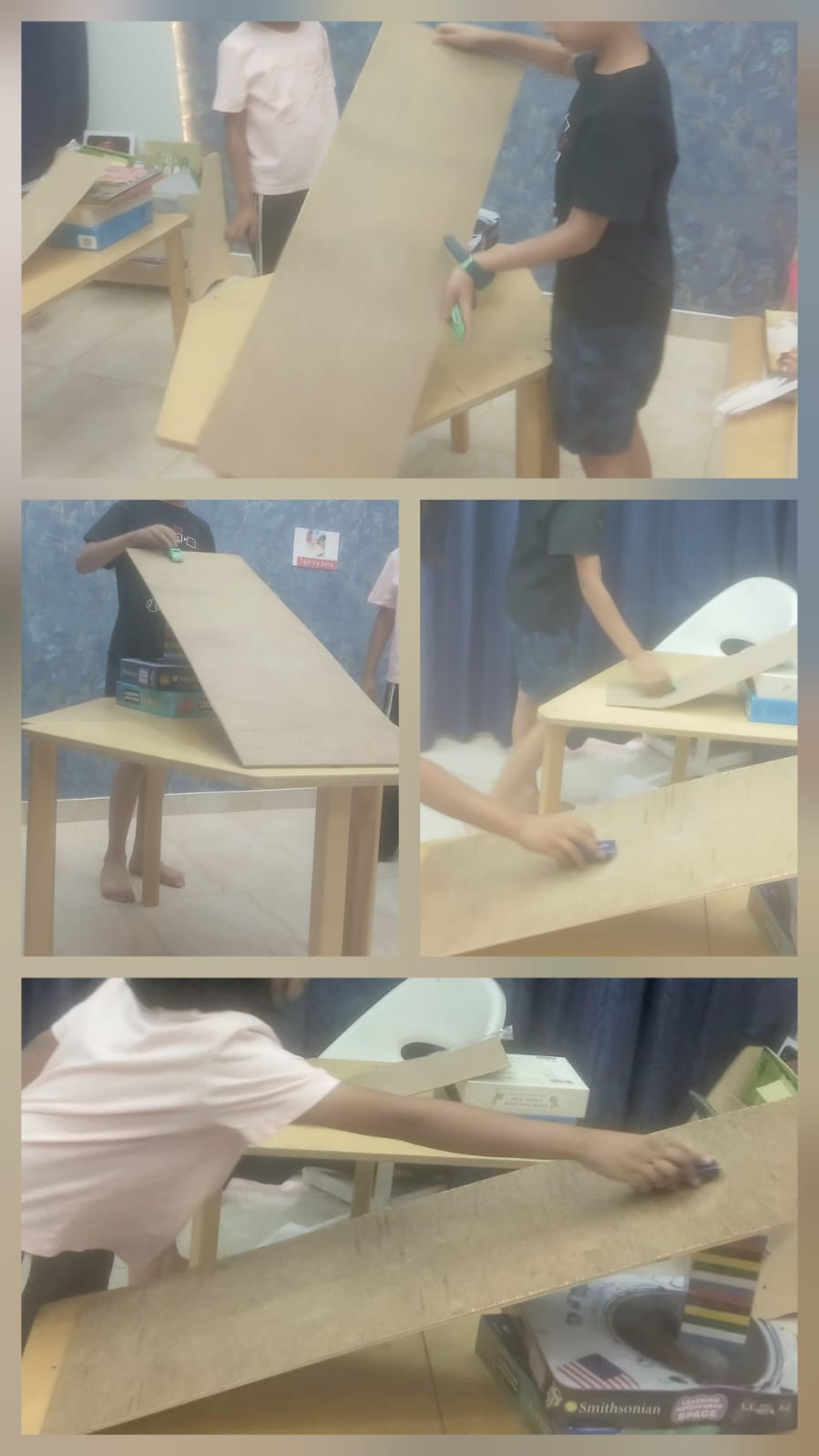
Neev and Mayra explored how to move a heavy object and shared that pushing it on a ramp is easier than lifting it straight up. Neev identified the ramp as an inclined plane, while Mayra explained that a slanted surface helps objects move faster with less effort. Through testing on a flat surface and a steep ramp, they observed that ramps make movement easier, while lifting requires more force. They also noticed that pushing objects upward on a ramp needs more effort.
During predictions, both children shared that a steeper ramp makes the car move faster. Neev explained that it comes down quickly, and Mayra added that a heavier toy might move faster because gravity pulls it down more strongly.
Through this activity, they understood that an inclined plane is a slanted surface that reduces effort, and that gravity, slope, and force affect how objects move. Neev & Mayra:7.7 years old
Dear reader,
I work with the school leadership team as an advisor and collaborate with teachers as a pedagogical trainer. I also help parents as a parenting counselor and regularly engage one-on-one with students as a personal guide and mentor. This weekly newsletter shares what I read, learn, and experience.
3-2-1 Tuesdays with Ms. Niv is a newsletter you can subscribe to and enjoy your learning journey with me.
 Nivedita Mukerjee