Nivedita Mukerjee
Education consultancy for parents and schools
Schools are opening. Teachers are preparing for blended learning. Parents, are you ready?

In absence of the safety net of vaccine and in order to put millions of children world over back into school, blended learning is emerging as the mid path for schools and for higher education. This year for sure and who knows, perhaps going forward as well. Shall we prepare for it then? Educators are getting ready with their newly/additionally acquired tech prowess for online teaching. Students are trying and mostly succeeding with a smile on. Parents, it is your turn now.

1.Screen : What screen size is ideal for e-learning? the learning sites make it convenient for various devices – mobile, tablets, laptops and desktops. But what is the best for your child? The online lessons are supported by quiz, quick text responses, on camera show and tell, sing alongs, theatre sessions, read alouds … besides just informal chats with teachers and peers when it is nice to see the class mates large and clear. So would a horizontal screen of a smart phone do? ummm… in a pinch may be. For some level of tertiary education… may be. But for primary and secondary education that is working on blended learning, a larger screen, a full key board and clear audio would definitely make more sense.
If it is not a possibility to give your child/ren access to laptop/desktop all through their e-learning sessions, you could consider sharing the big screen devices in rotation so that everyone gets to use the large screen and full key board. You can also consider some improvisations like attaching accessories to the mobile. Noise cancelling head phones, a key board, a second hand monitor, all of which could be affordable solutions that would significantly enhance the online learning experience. It is also easier to monitor activity of the child/ren and limit the access to the device to manage screen time with a larger screen than handing them a smartphone.


A dedicated space for learning would be very necessary to have for the child to be comfortable with blended learning scenario. Your child/ren are going to spend time here ‘going’ to school and not just homework or test prep. Many of us as adults have created dedicated spaces for working from home during this long lockdown. Carve out such a space for your child/ren as well. Where there is quiet and comfort. The furniture is ergonomic and devices can be placed to work, with charging access, space to keep their textbook, notebook and relevant stationery, bottle of water and school bag. Pretty much replicating their class desks and cubbies.
If it is not a possibility to give dedicated rooms to your child/ren, corners in dining room, living room, bed room can be set up specifically with desk, chair, shelving/school bag and charging station. Places where members of the family do not play games and watch television. Spaces that have enough light and ventilation like the loft, the staircase landing, spare bathroom, a mezzanine, the extra bedroom of the house converted temporarily to workspace for entire family to learn/work from. That leaves the living room for gathering, watching TV, playing games, pets and extended family to still carry on with their routine without interfering with school/office work.
3. Schedule
This is the first time in history that adults and children both are working from home. Which means that schedules become even more important. This is not a vacation time for child/ren. They have to attend classes, do the tests, submit the assignments and appear for exams. None of this is going away anytime soon. It would become very difficult to play catch up on grade appropriate learning of school curriculum if they are lax now. Discuss with their class teacher/s on the timetable of online classes. See if there are enough breaks and discuss if you think more/less breaks than scheduled would help in your child’s learning. Teachers and the school will thank you for the feedback. Everyone is figuring it out so more we collaborate on making it work, more will be the chances of success. The partnership between parent and teacher for child development has taken a new dimension which requires parents to fill in more in education and the teacher, in emotional development.
Moving out from the designated study space to the dining area during snack and lunch times will be good to consider. Even for you when you are working from home and enjoy little breaks together through the day. It would energise everyone to have an off-screen time with real interactions and possibly play with the pet or even do part of a pending household chore that has been allocated to each family member. Perhaps even catch a quick nap. Doing something like painting, craft, making music, journaling with pen on paper, making 2D/3D project, skipping rope, putting a ball through hoop, working on a big puzzle over days would trigger different parts of the brain and are great off-screen activities.
When times are stressful and unpredictable, a predictable schedule is a great way of managing emotions, getting spouse/extended family’s help to manage your child/ren’s needs and being productive at the same time.
So go on, discuss with your family how you can make Screen, Space and Schedule work for each of you. Then don’t hesitate to review it periodically and tweak. While at it, keep in touch with other school parents and share notes. Have your children set up play dates with video chats. Play online quiz and Antakshari. Visit online museums and travel shows together.
Schools are opening soon. Teachers are prepping for it. How are you setting up your child/ren for blended learning? Please share your plans with me and the readers of this blog. Do reply to this post and subscribe. It is easy and free 🙂
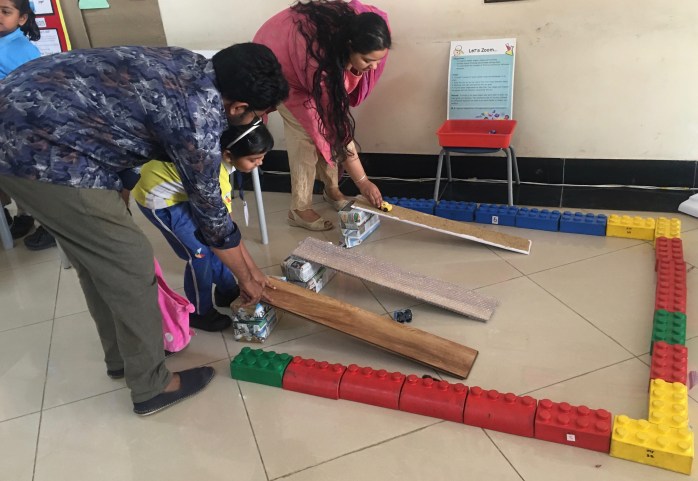
P.S. Here’s a picture from a science project done by govt. school children from the district of Belgaum, Karnataka, India. Projecting mobile phone on large screen. Meant to be used by the schools that do not have projectors or smart boards. How about making it work for blended learning at home?


 Nivedita Mukerjee
Nice and very infomative
LikeLiked by 1 person
Thanks for this article. As I see it this pandamic has shaken our souls and made two things very clear.. how uncertain the life is and for living it to full, we never stop learning. All the world is a school and all of us are mere students, though at different stages. All these points mentioned here are applicable to everyone!
LikeLiked by 1 person
Well said!We need to accommodate to new situation. Liked the idea of projecting on larger screen . Thanks a lot.
But being in government college we are handling children who don’t have any equipment for online studies. We need to think about them too
LikeLiked by 1 person
Indeed that is a challenge Kavita. I am working with some govt. schools with a foundation as their CSR project and also with a NGO focussed on education for the underserved. Efforts are to reach them refurbished hardware and create wifi hot spots with mobile vans… will share more thoughts as we get around to experimenting and giving our best shot to bridge this divide.
LikeLiked by 1 person
What a fantastic creation you are.your toughts are out of box from others.
LikeLiked by 1 person
Thanks Jyoti Rajeev. As I work with a wide spectrum of schools and Universities, it gives me opportunities to learn and share. Learning at the pace of crisis…
LikeLike
Thanks a lot
LikeLiked by 1 person
This blog is the need of the hour. We the educationists will definitely try all possible ways to render quality education at a minimalist approach.
LikeLiked by 1 person
A simplest concern of all the parents now, you have put it up so smartly Ms Niv 🙂
LikeLiked by 1 person
Very useful information Nivedita, when children and parents are going to see a huge change in the education system – shifting to technology.
LikeLiked by 1 person
I find that before getting into the work mode/space getting into appropriate clothing a.k.a – getting out of p.j.s marks a division, supporting the transition and managing mood/mindset in the way that designated work spaces and routines do.
Thanks for sharing such a comprehensive set of tips for blended learning.
LikeLiked by 2 people