Nivedita Mukerjee
Education consultancy for parents and schools
3-2-1 TUESDAYS WITH MS NIV
Issue #14 / October 13, 2020
Easy choices are, well – easy to make. One alternate trumps the others in more than one ways. In a hard choice one alternate is better in one way, another one is better in some other way. Neither is better than the other over all. What do you do? Flip a coin? Go for the safer option? In this issue, find some infographics that will help clear the muddy waters around hard decisions. Listen to Ruth Chang in the video of the week in her life altering talk on How To Make Hard Choices. Don’t miss playing with Bangles this festival season with your family, check out the And Finally.. section with Ms Sonal.
Subscribe, share, comment. Feel free to follow me on social media where I post education related content.
Follow Me
Get new content delivered directly to your inbox.
Three Images For The Week
For educator, parent and student. The Holy Trinity of Education.


Two Thoughts For The Week
“You can’t make decisions based on fear and the possibility of what might happen.”
― Michelle Obama
“It is often said that a wrong decision taken at the right time is better than a right decision taken at the wrong time.”
― Pearl Zhu, Decision Master: The Art and Science of Decision Making
One Video For The Week
The world of value is different from the world of science. That is the stuff of hard decisions we face as humans. In both small and big tasks. Here’s a talk that could literally change your life. Which career should I pursue? Should I break up — or get married?! Where should I live? Big decisions like these can be agonizingly difficult. But that’s because we think about them the wrong way, says philosopher Ruth Chang. She offers a powerful new framework for shaping who we truly are.
Guest Column
Pavitra Umashankar, Teach For India Fellow.

Corona Diaries
I started this year with a lot of enthusiasm, a new zeal. I knew this year is going to be different. I had in August 2019 taken part in the assessments “Teach for India” conducted. I was impressed by their professionalism, to select teachers for government and low income private schools, a profession that is thought of not so highly in our society. I was supposed to start my stint in “Teach for India” with a one month long training in May in Pune. I had many years of corporate experience but this was going to be different. I was already dreaming about “back to college days” fun, staying in FLAME hostel with lot of fresh graduates and feel as one myself. I was getting set to be away from home for a month and have a lot of Vada paavs in the streets of Pune.
I was thinking of booking flight tickets and news of Corona Virus in China spreading trickled in slowly. The news of COVID in China did not make much of an impact considering we do not watch TV at home. Newspapers did not color as scary a picture as television and other media would do. On the day of March 20th, PM Modi announced banning of all international flights. The PM then came on national news channels and announced a complete lockdown from March 25th 2020. I stocked up few groceries and essentials that would last for a month. It was a time to bond with family and spend some quality time at home. It was time to try out all new recipes. It was also a time to efficiently divide and finish all the chores at home with good planning since the maids would not enter the community. Least did I know a different story unraveled in many many lives across the country.
Today after 6 months of the complete lockdown, with Vada Paavs of Pune still a far dream, with the online training that was imparted to us, I sit in my room, teach 20 plus kids on zoom every day and a different story unfolds every single day. My students’ parents belong to the informal sector as we call it, but they are the engine which runs the economy. My students’ parents are auto drivers, cab drivers, factory workers, garment industry workers, small business owners and BMTC workers. I now realize firsthand what lockdown is for them. Some of them have one basic smart phone at home, that affordability was there till last year. Today they have to manage to educate their kids with that one smart phone at home. They are struggling to pay the admission and tuition fee of 5000/- to school couple of months after online teaching has started.
My students have charmed me. I am particularly impressed with one girl in my class. Gunashree has very good RC, writing and Math ability as per her performance report last year. Her mother is a single parent trying to make ends meet. She works in a small hotel washing vessels, but dreams big for her child. Gunashree is 9 years old who gets up in the morning cooks for her brother and herself while her mom goes to work. She is the first one to login to online class at 9:30 A.M every day through a phone, a phone which I could give Gunashree because of the funding from a good Samaritan. Gunashree is so full of life, her beaming, confident voice on zoom answering all the questions and Math challenges that her Ma’am throws at her.
I prepare colorful ppt’s for my students, call up parents almost every day and entice them towards online learning with an intention to increase attendance only to realize that when my student strength in zoom is more than 10, my students on their phone interspersed with poor connectivity, constantly get disconnected, some of them are barely able to hear me. I then realized that being a elementary school teacher is 80% drama and 20% teaching and that is what keeps me going today. Dramatizing the teaching and learning
If not anything I have learnt a lot in this lockdown. I have learnt important life lessons. “Teach for India” in their one month training taught us “how to teach/ the pedagogy/dealing with any situation with a lot of empathy”, but the kids teach you a lot more on a daily basis. They have accepted their new teacher and given her a lot of love without meeting her face to face even once. They are malleable, they are the sponge which sees you and absorbs. There seems to be no end in sight for the pandemic but seeing the joyful faces of my students everyday morning have taught me that it does not take a lot to be happy
In awe of the ever adaptive world
Parent Speak

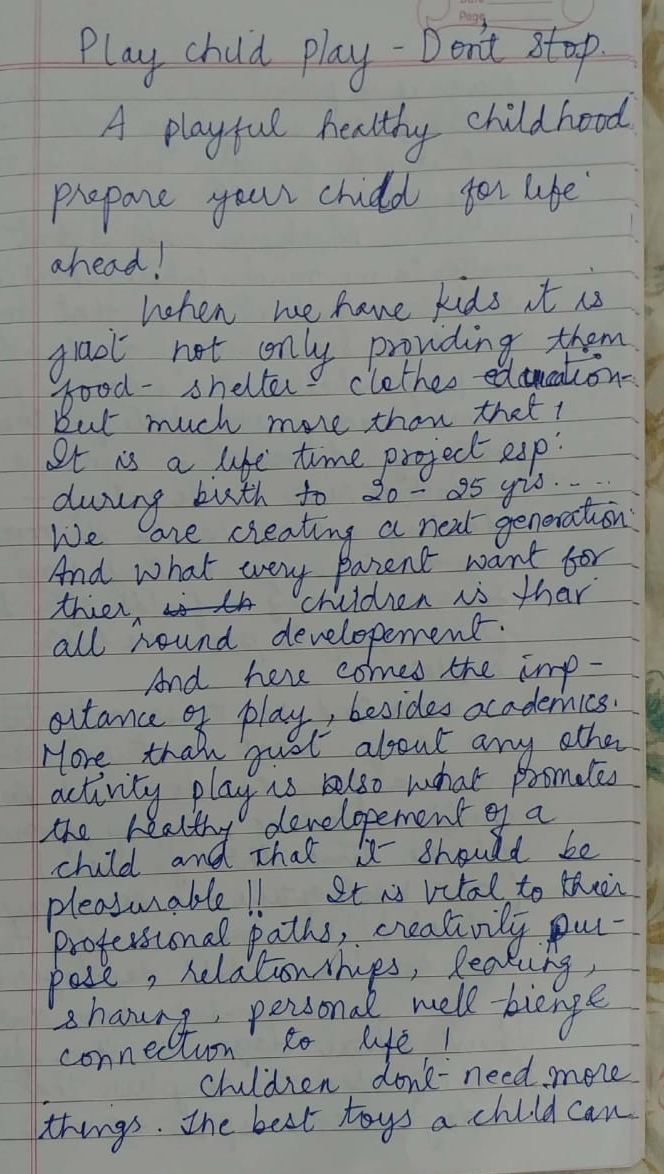


Student Voice
Akshitha Upadyayula, Student of Grade 12

“If I had an hour to solve a problem I’d spend 55 minutes thinking about the problem and five minutes thinking about solutions.” – Einstein
At first glance, this seems quite counter-intuitive since we have been taught that knowing the right answer is extremely important. However, Einstein seemed to believe that our ability to correctly identify the problem is directly proportional to the quality of the answer.
To understand a problem better you must be open to the possibility that there is more than one solution and actively question it. Challenge your previous values, assumptions and principles in an attempt to rethink and reinvent yourself.
Asking questions stimulates critical thinking – where the aim is not to make you afraid of having the wrong answer, but for you to closely examine and clearly articulate your beliefs. This is termed “productive discomfort”.
As students, we must understand that questioning is both the art of learning and the best evidence of understanding. Pursuing fearless thought, dedicated action and forgiveness for ourselves is something we cannot be taught but can discover through the process of questioning.
The beauty of this process lies in the idea that we don’t have to feel the burden of having all the correct answers. We have the freedom to come up with questions that lead to the heart of the problem. We will be able to stand by our values knowing that we have delved into ‘why’ we see the world the way we do.
These skills are vital to our growth and the way we approach the world. So I invite you to ponder over the thought that the “quest is for the question, not the answer” and see what you make of it.
Showcase
Saraswathi Padmanabhan, founder Diya Ghar.

Diya Ghar is an NGO for children of migrant labourers. We run Montessori Preschools and Day Care Centres in Bangalore. Our focus is nutrition, education and community engagement.
When the COVID19 pandemic hit us, our migrant communities were affected very badly. Children are now in a very vulnerable state and without an intervention like ours they are at the risk of developing nutritional deficiency. Their development is also hampered due to lack of stimulation and activities. We have therefore changed our model to continue to support children and their families during this time. Our interventions include:
- Nutrition: We are providing nutritional supplements (milk, eggs, porridge mix) for all children and distributing dry ration kits for families who are in desperate need.
- Parent Empowerment: Through a curriculum of weekly video sessions we are teaching parenting skills and activities that they can do with their children. We follow up with calls and community visits.
- Early Childhood Education: We are supporting the development of children by sharing video content. We follow up with calls and community visits.
Four year old Srinivas joined Diya Ghar in the beginning of February 2020. His family is from Bellary. They came to Bangalore about 5 years ago and they work as construction labourers. Srinivas was very malnourished and initially didn’t like to drink the porridge in school. He was also a shy boy who took a couple of weeks to join the group activities. What he loved doing was sitting by himself in the reading corner and going through story books. When we introduced activities using beads and cloth pins, we noticed that his fingers were very stiff. We were happy to see improvement over the month. He also started drinking porridge!
And then preschools were closed on March 10th 2020! We wondered how Srinivas was doing. We then started giving his family and the community dry ration kits and also nutritional supplements for the children (milk, eggs, porridge mix). We were surprised to hear that Srinivas enjoyed drinking the porridge. We then started sending his parents videos of activities to do. His mother understood the importance of Srinivas doing activities to strengthen his muscles. We were delighted when they sent us a picture of him doing an activity with clothes pins! His mother tells us that he loves to listen to videos on spoken English and is repeating a few words. We are glad that even during this pandemic, Srinivas can continue to get nutritious food, do activities to aid his growth and continue to learn!

www.diyaghar.org, contact@diyaghar.org, +91 63607 09332
_______________________________________________________________________________
And Finally..
Ms Sonal shares how you can learn and play with Bangles this Navratri in this fun video. Enjoy.
_________________________________________________________________________________________________________
3-2-1 Tuesdays with Ms Niv is a newsletter for you to subscribe and enjoy your learning journey with me. Most of you would have been too busy to track trends in education, ponder on most relevant thoughts or deliberate on career choice, parenting or pedagogy. Find it all here. This week, it consists of: 3 images, 2 thoughts and 1 video.
For whom? Students, educators and parents
When? Every Tuesday
Where? my blog post, register with your e-mail id, it is free.
If you want to contribute an article, are organising an event, have a product that you think can be reviewed and/or featured in this news letter, please feel free to write to me at : niveditamukerjee10@gmail.com
Please like, subscribe, share, comment. See you next week.
This newsletter is supported by:


 Nivedita Mukerjee
Loved going through all the columns. Kudos to everyone involved in Teach for India and specially ,Pavitra, great job!!!
LikeLiked by 1 person