Nivedita Mukerjee
Education consultancy for parents and schools
3-2-1 Tuesdays with Ms Niv

Issue #280, 11th November 2025
What if someone told you that each of us are not reacting to the world but are responding to our predictions of the world from our past experiences. Check out the ted talk in this issue if this has piqued your curiosity.
How would you enhance your home or classroom environments? How would you improve your interactions and exposures to indoor and outdoor experiences for our children or students? If our goal is to interact with the world around us with curiosity and a spectrum of empathetic emotions, instead of judgment and exclusion, how can we design for it instead of leaving it to chance?
This is a free newsletter. If you like my content, please subscribe by entering your email address here.
Three Images of the Week

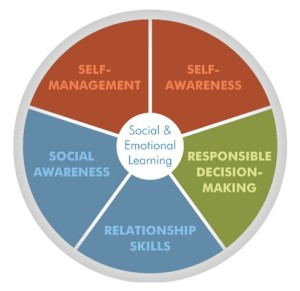

Two Thoughts of the Week
“In between every action and reaction, there is a space. Usually the space is extremely small because we react so quickly, but take notice of that space and expand it. Be aware in that space that you have a choice to make. You can choose how to respond, and choose wisely, because the next step you take will teach your child how to handle anger and could either strengthen or damage your relationship.”
― Rebecca Eanes, The Newbie’s Guide to Positive Parenting
“Absence of emotion is not maturity,” she said, “though it’s easy to mistake. Part of maturity is learning to deprioritize emotion, prevent it from taking the reins. But a large part is perspective, long-term decision making.”
― Mishell Baker, Phantom Pains
One Video of the Week
Can you look at someone’s face and know what they’re feeling? Does everyone experience happiness, sadness and anxiety the same way? What are emotions anyway? For the past 25 years, psychology professor Lisa Feldman Barrett has mapped facial expressions, scanned brains and analyzed hundreds of physiology studies to understand what emotions really are. She shares the results of her exhaustive research — and explains how we may have more control over our emotions than we think.
Reading with Ms. Meenu: Tip of the week
Letter Knowledge:
As experienced readers, it’s easy for us to forget that letters are just arbitrary marks on paper. The collection of dots, lines and circles could mean anything. It’s a process to learn to distinguish letters from pictures. It’s also a challenge to remember which letter is which. After all, b and d, for example, are quite similar-looking.
In one of my absolute favorite picture books, An Inconvenient Alphabet, Beth Anderson explores the arbitrariness of our letters in genius fashion as she recounts the true story of Ben Franklin and Noah Webster’s shared belief that English has letters with too many sounds.
Kids need to know about letters and discern the speech sounds within words. But that’s not all; they also need to be able to reliably recall which letters make which sounds so they can decode the print they see.
That’s why the best initial reading instruction in English directly teaches kids the links between letters and sounds, also known as phonics. It’s a basic fact of English that the sounds of the language are represented by the letters of the alphabet. Grasping the connection between the symbols and sounds is a necessary step that puts children well on their way to reading. Memorizing whole words one by one, not so much.
The teaching routine for parents is straightforward: Point to a letter and ask, What sound? If the child gets it right, say, Great work matching the letter to its sound. If they get it wrong, give them a correction. You can make the activity playful by passing a fake microphone back and forth or asking the question in a silly voice — whatever engages the child.
Happy Reading!
Meenu Gera
Consulting home and school librarian reading guide
I Think, I Wonder, I Ask
–Dr Shreelakshmi Subbaswami, Academic Director, Vijaya School Hassan, Karnataka
The Power of Small Shifts: Rethinking Classroom Observations
As a researcher in education, classroom observations were a big part of my work. Most often, I observed as a non-participant—watching to understand what was happening and why, connecting classroom snapshots to educational theory. Early on, I noticed how the very word observation created anxiety. Years of industry-model schooling had conditioned us to see it as evaluation, not support.
When we began our own observation rounds, the purpose was made clear- to connect, impact, and mentor. Each one could help the other grow. Over time, I began to see a constant cycle of observation and reflection: how can our efforts be both effective and efficient within a 40-minute class? How can we make the most of every minute without overwhelming either the teacher or the learner?
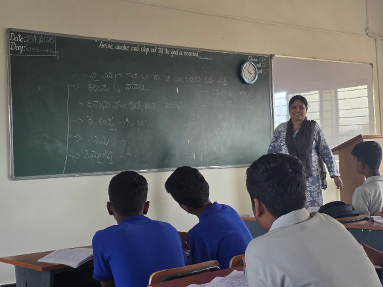
During one such round, a Kannada class stood out. The teacher led a story discussion with thoughtful questions, writing key responses on the board. Yet, engagement was uneven — a few participated while others observed passively. Her focus on the board limited her movement, and students’ thinking stayed anchored to her questions.
After class, we reflected: how could students hold the tool for thinking themselves, rather than wait for the teacher? Together, we co-created a simple thinking template for group work. The very next session was transformational — all students engaged, analyzed the text deeply, discussed ideas freely, and even wrote well. The class shifted from a teacher-led, board-facing activity to a lively circle of shared thinking and writing.
This experience reaffirmed for me that real impact doesn’t always come from grand strategies, but from small, intentional, and doable changes. When observation is rooted in trust rather than audit, change feels both possible and sustainable.
Three questions for you…
How can we make classroom observations feel like support, not supervision?
What is one small change you can make that might shift the way you teach or lead?
Which observation—by a student, colleague, or family—has helped you improve?

Dear reader,
I work with the school leadership team as an advisor and collaborate with teachers as a pedagogical trainer. I also help parents as a parenting counselor and regularly engage one-on-one with students as a personal guide and mentor. This weekly newsletter shares what I read, learn, and experience.
3-2-1 Tuesdays with Ms. Niv is a newsletter you can subscribe to and enjoy your learning journey with me.

