Nivedita Mukerjee
Education consultancy for parents and schools
3-2-1 Tuesdays with Ms Niv

Issue #320, 18th August 2026
Connection. The most important human skill that will take our students and us through the unknown future is left to chance. It is not taught by design. It is not visible in classrooms. It is not part of the lesson plan. It is definitely not foundational to teaching subjects by teachers and thus not part of teacher training. Loneliness has been officially declared an epidemic for all ages, across countries. What can the educational system do about it? A system that has not changed for several decades- what can educators and parents do? Pause. Ask. Observe. More than Judge. Tell. Show. Not easy. But possible.
Schools were designed to focus on grading. On schedules to manage time. Not environments that support connection or campuses and classrooms that support relationships among students, among teachers, and among students and teachers. Every part of the school is designed to manage supervision and/or efficiency of space or movement or time or content delivery.
What can we do now? Wait for a systems overhaul or overhaul our own operating systems one section, one grade, one student at a time? Performance v/s Presence. What do you think? Outsource our connection to technology? School ERP system? Group WA messages? Only/Or plug in some personal relationship building alongside.
This is a free newsletter for parents, educators, and students. If you like my content, please subscribe by entering your email address here.
Three Images of the Week


Two Thoughts of the Week
“Learning about students’ families and the lives they share outside school walls is the first and most important step toward getting connected to students.”—From You’re Going to Love This Kid!, Third Edition, by Paula Kluth
“No student does better by feeling worse about who they are.”—From The Re-Set Process by Dyane Lewis Carrere with Wynne Kinder
One Video of the Week
Connection matters more than curriculum—here’s why | Nathalie Blais |
Schools teach math and science, but what if the skills that matter most aren’t taught? Nathalie Blais challenges the current academic system’s ability to prepare children for life. She argues that connection and belonging are skills that belong in every classroom, helping students build emotional well-being while developing into future leaders. Drawing on her research, classroom experiences, and coaching work, Blais shares a framework for building meaningful connections through active listening and understanding. This talk presents a new approach to education that focuses on human connection. Nathalie Blais is the Founder and CEO of Coach Academy and an IF Master Certified Coach whose work focuses on how people think, connect, and lead. Her central idea is both simple and disruptive: connection is not an assumption —it is a skill. At a time when communication is increasingly reactive and transactional, she challenges people to reconsider how influence is built and how change actually occurs.
She argues that coaching skills are connection skills, and that coaching has become the language of influence, inclusion, and meaningful exchange. Rather than fixing or directing, her work emphasizes creating the conditions for insight, responsibility, and growth —an approach that has shaped how leaders, educators, and coaches engage across systems and cultures.
Blais holds a Master’s degree in Psychology from Harvard and has logged more than 50,000 hours in facilitation, learning design, research, and education development. She is the architect of multiple ICF-accredited coach education programs and has trained thousands of leaders and coaches worldwide. A contributor to Forbes Coaches Council, she explores fear, motivation, grief, compassion, and connection in her research. Her forthcoming 2027 book examines why human-centred connection is becoming a critical skill in an increasingly automated world.
Reading with Ms Meenu: Tip of the Week
Libraries Beyond Bookshelves
Libraries today are much more than places where people borrow books. While books remain an important part of every library, modern libraries have become community spaces that support learning, technology, creativity and social connection.
One of the biggest changes in libraries is the growth of digital resources. Many libraries now provide e-books, audiobooks, online newspapers, research databases and educational websites. People can often access these resources from home using a library card. Libraries also offer computers, Wi-Fi and technology support, helping people who may not have reliable internet or devices of their own.
Libraries are also becoming centres for creativity and hands-on learning. Some offer makerspaces with 3D printers, recording equipment, sewing machines and other tools. Workshops may teach coding, digital skills, crafts, financial literacy or career development. These opportunities allow people to learn practical skills in an accessible environment.
For children and families, libraries provide much more than storybooks. Storytimes, reading clubs, homework help, STEM activities and summer reading programs encourage children to learn while having fun. Libraries can also help children discover books that match their personal interests, making reading more enjoyable.
Libraries also play an important social role. They provide welcoming spaces where people can study, meet others or simply spend time without being expected to purchase anything. Newcomers, seniors, students and job seekers may use libraries to access community information, language programs, employment resources and government services.
In addition, librarians have become important guides in a world filled with information. They help people locate reliable sources, conduct research and recognize misinformation. As artificial intelligence and digital information continue to grow, these information-literacy skills are becoming increasingly important.
The modern library has therefore moved far beyond the traditional bookshelf. It is a place for books, but it is also a technology hub, classroom, creative space, research centre and community gathering place. By adapting to changing needs, libraries continue to remain valuable and relevant in everyday life.
Happy Reading!
For more information please visit: placealibrary.ca
Meenu Gera
Consulting Home and School Library Reading Guide
I Think, I Wonder, I Ask
–Dr. Shreelakshmi Subbaswami, Academic Director, Vijaya School, Hassan, Karnataka; https://vijayaschoolhsn.in/
Freedom in Schools
This Independence Day, sharing my thoughts on what freedom can really mean in a school. Beyond the celebrations and words we hear every year, how much freedom are we actually giving our children and teachers?
For children, freedom can begin with something as simple as giving them space to speak without immediately correcting them. It is allowing them to solve problems instead of fixing everything for them. It is giving them choices and helping them make informed decisions. It is creating a classroom where they can ask questions, share opinions, make mistakes, create without worrying about being perfect, and discover their own paths. It is also giving children the freedom to imagine the life they want to build and not imitate others.
The same applies to teachers. Freedom is trusting teachers to choose content that is meaningful to children, explore different pedagogies, try new strategies without the fear of being judged, and make mistakes, rectify as they learn. It is allowing teachers to discover their own ways of teaching.
Perhaps freedom in a school is not about removing boundaries. It is about creating enough space for children and teachers to think, question, choose, try, make mistakes and discover…
Three questions for you…
- How might our schools change if we gave children and teachers more freedom to imagine, question and create?
- Why do we sometimes find it difficult to give children the freedom to make their own choices?
- In what ways can we give teachers freedom to experiment and discover their own teaching styles?
Showcase: Thrive STEAM project, Hyderabad; https://thrivesteam.com/
Pooja Khatter, facilitator
Exploring Soil, Seeds and Plant Growth
The two-day workshop was filled with curiosity, observation, questioning, and problem-solving as the children explored soil, seeds, and how plants grow.
The children began by looking at their previous soil layer jars. They observed that the soil had formed different layers and noticed differences in the colour, size, and texture of the soil particles. They shared their observations through drawings and writing.
Samyuktha, Tara, and Krisha explored different soil samples using magnifying glasses. They noticed that the soils looked and felt different. They compared their colour and texture and used their sense of smell to identify soil and manure.
During the soil layer experiment, the children made predictions about which soil would absorb water. Samyuktha said sand would absorb water first, followed by black soil, while Tara predicted red soil followed by sand. As they observed the jar, they noticed that the soil particles settled at different times and formed visible layers.
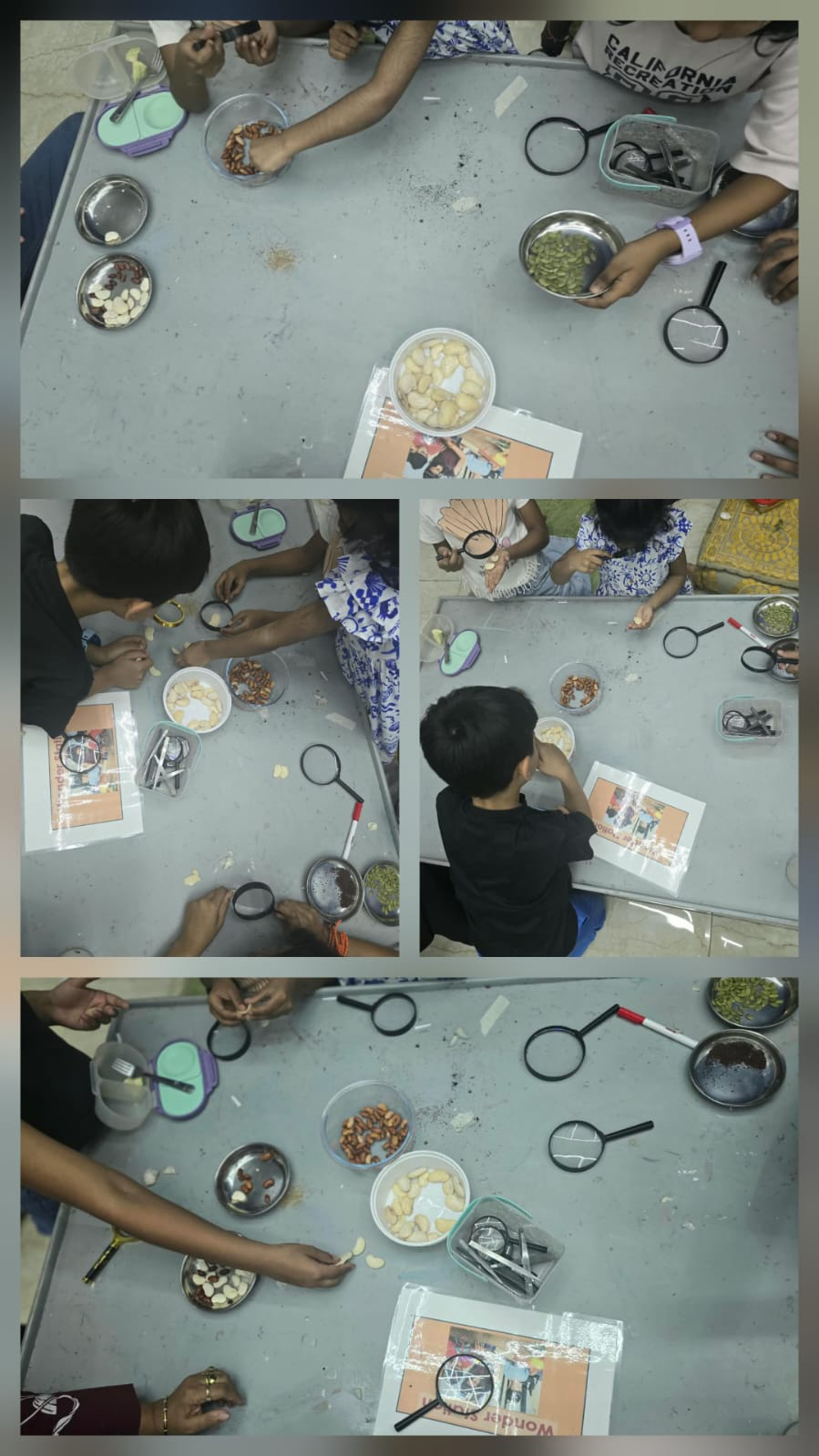
The children then became Seed Investigators. They observed mustard, pumpkin, lima, and kidney bean seeds and compared their size, shape, and colour. They also compared soaked and unsoaked seeds and noticed that the soaked seeds had become bigger and softer.
When they opened the soaked seeds, they observed the seed coat, embryo, and stored food inside. They understood that these parts help the seed begin to grow.
The children watched a video about tiny seeds and discussed what seeds need to grow. They identified water, air, the right temperature, and a suitable place as important for seed growth.
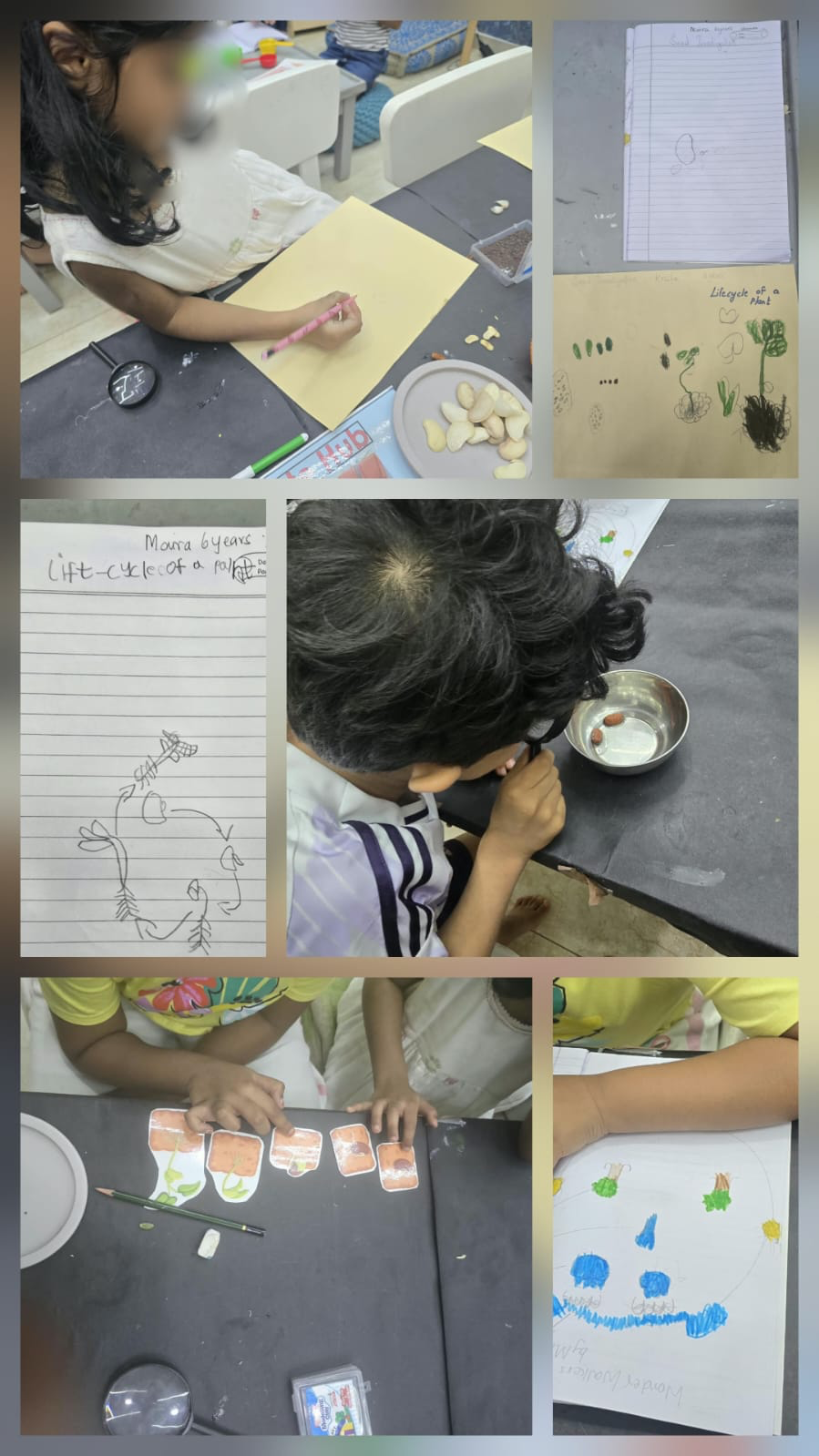
They then explored the plant life cycle by arranging the stages in order. They understood that a seed germinates, develops a root and shoot, grows into a seedling, and eventually becomes a mature plant that produces new seeds.
The workshop ended with the children showing their understanding through drawings, sequencing activities, and journal work about the plant life cycle. Krisha:4 years old. Maira: 6 years old. Tara:6 years 11 months old. Neev, Mayra,Yuvaan & Tashi :7 years 11 months old Samyuktha: 8 years 4 months old
Teacher for Teachers
Our Little Seed Explorers!
This week, our little seed explorers touched and looked at different seeds — mustard, pumpkin, lima, and kidney beans — and compared their size, colour, and shape.
They found out that seeds soaked in water became bigger and softer. When they touched the seeds, they were able to feel the seed coat. They then opened the seeds to see the embryo, the part inside that helps a seed grow into a plant.
The children also learned what seeds need to grow: water, air, and a good place to grow.
Finally, they learned how a seed grows step by step — from seed to root and shoot, to a small plant, and then a full-grown plant. They shared what they learned through drawings.
Dear reader,
My work in education includes designing learning ecosystems where students thrive, teachers grow, and schools build lasting cultures of excellence through innovative curriculum, evidence-based practice, and meaningful educational leadership.
Professional development with Ms Niv : Click below to find the teacher and student workshops and trainings I currently offer:
https://docs.google.com/presentation/d/1ypWO8KpVh56vhYqAMH4XoytLRKMXvwpCAfv3l3fryJQ/edit?usp=sharing
3-2-1 Tuesdays with Ms. Niv is a newsletter you can subscribe to and enjoy your learning journey with me.