Nivedita Mukerjee
Education consultancy for parents and schools
3-2-1 Tuesdays with Ms Niv
Issue #332, 10th November 2026
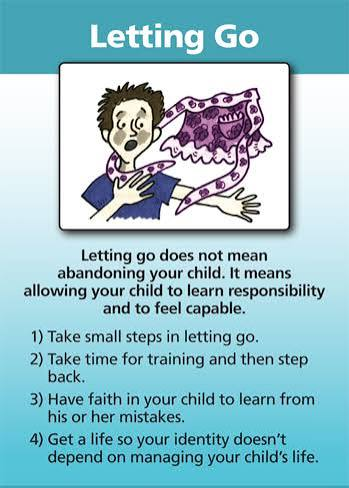
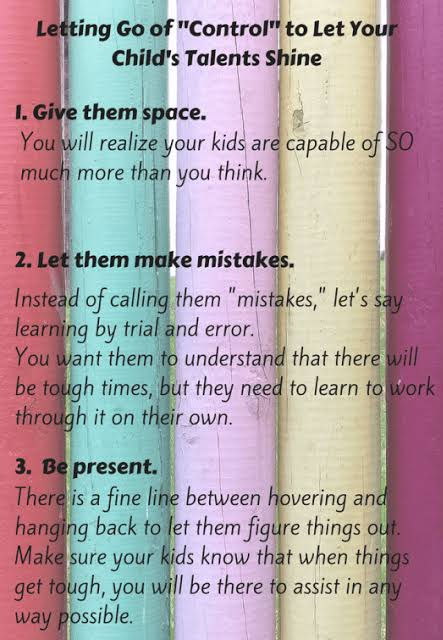
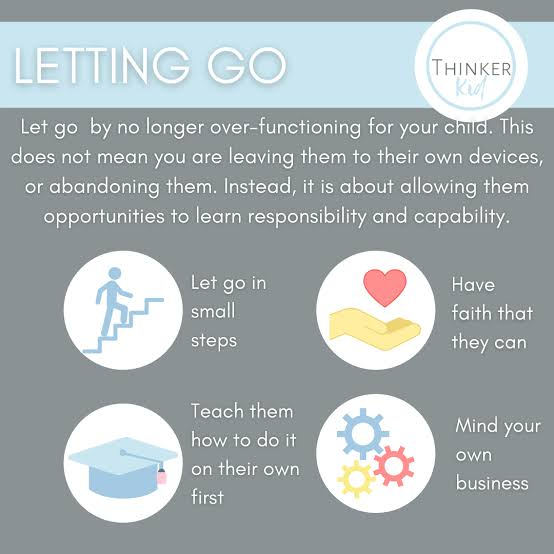
When are we ready to let go of our children? Our students? When do we stop saying ‘NO’ or ‘Be Careful’ or ‘Later’ or ‘When you grow up’?
Which of their actions make us say the above? Which actions do we hover over them because of our own fears?
When do we figure what action of theirs need our support and which ones they need to figure themselves out?
This is a free newsletter for parents, educators, and students. If you like my content, please subscribe by entering your email address here.
Three Images of the Week
Two Thoughts of the Week
“Growing up is an adventure for parents too. As your child grows and leaves, you too must also learn to live without them under your 24-hour care.”
“Let go of your grown children with grace. They will always need you. But the needs will be different.”
One Video of the Week
“No, no, no. We kids hear no all day!” Ever felt micromanaged? Gwen shares how kids can be capable of some pretty cool stuff with a little more independence at home and at school. Gwen Coffey is a 4th grader at Cajon Valley Union School District.
Reading with Ms Meenu: Tip of the Week
Developing a lifelong reading habit is rarely the result of a single school lesson or library visit. It grows through encouragement, access and repeated positive experiences.
In a world full of digital distractions, parents, schools and libraries must work together to create an environment where books remain meaningful.
Parents play an important role by introducing reading early. Reading bedtime stories, visiting libraries and discussing books during everyday conversations can make literacy part of family life.
Schools can build on these habits by giving students opportunities to explore books beyond the curriculum. Classroom libraries, reading circles and student-led book recommendations can help children discover stories they genuinely enjoy.
Public libraries contribute by providing free access to books and reading programs, including resources that families might not otherwise be able to afford.
This accessibility is particularly important because reading opportunities are not equally distributed.
The National Literacy Trust reported in 2025 that approximately one in ten children and young people surveyed did not have a book of their own at home, with greater disadvantage among children receiving free school meals.
https://literacytrust.org.uk/research-services/research-themes/reading
The challenge for adults is to encourage reading without turning it into a source of pressure.
Children who struggle with long novels can begin with graphic novels, illustrated nonfiction, poetry or shorter stories. What matters is building confidence and curiosity.
Technology can also support the effort through digital borrowing, audiobooks and recommendations, provided it does not entirely replace opportunities for focused engagement.
The message: Raising readers is a shared responsibility. Every parent, teacher and librarian can help make books part of a child’s everyday life.
Meenu Gera, Consulting Home and School Library Reading Guide
Happy Reading!
For more information, please visit: placealibrary.ca
I Think, I Wonder, I Ask
–Dr. Shreelakshmi Subbaswami, Academic Director, Vijaya School, Hassan, Karnataka; https://vijayaschoolhsn.in/
Learning to Read the Process Behind Learning
As educators, how often do we move beyond observing what happens in a classroom to understanding why it happens?
When we observe classrooms across different grades, can we look beyond documenting what a teacher did and how students responded? Can we identify commonalities and differences in the learning processes, resources used, classroom environments, and outcomes? For instance, if students across three classes struggle to explain a mathematical concept, could the gap lie in how the concept was introduced rather than in the children’s ability?
Similarly, when we assess students, we often report that a concept has not been attained or a learning outcome has not been achieved. But can we go a step further? Can we identify precisely where the learning gap exists? Is it in the child’s understanding of a prerequisite concept, the vocabulary used, the sequence of instruction, or the opportunity provided to practise and apply the learning? A learning gap is not merely something to report, it is an opportunity to investigate what might have caused it.
These are skills of analytical observation, pattern recognition, diagnostic reasoning and root cause analysis. They are interconnected and draw upon systems thinking; it’s the ability to see how different elements of the teaching-learning process connect and influence one another.
Like scientists, educators need to investigate, question, trace evidence, and decode processes step by step. The more precisely we understand the process, the more meaningfully we can improve it.
Have we consciously developed these skills?
Three questions for you…
- Can we distinguish between a child’s difficulty in understanding a concept and a gap in the way it was taught?
- What evidence do we collect during classroom observations to understand the teaching-learning processes?
- How can we consciously develop analytical observation, diagnostic reasoning, and root cause analysis as everyday skills among educators?
Showcase
Thrive, A STEAM project for young learners https://thrivesteam.com/
Facilitator: Pooja Khattar
CHOOSING THE BEST SITE AND FROM SATELLITE IMAGE TO MAP The workshop began with a recap of the previous session, as Havishka and Samyuktha had missed the earlier class. Samyuktha showed curiosity by asking, “What did I miss in my previous class?” This allowed us to revisit the earlier discussions and help her catch up.
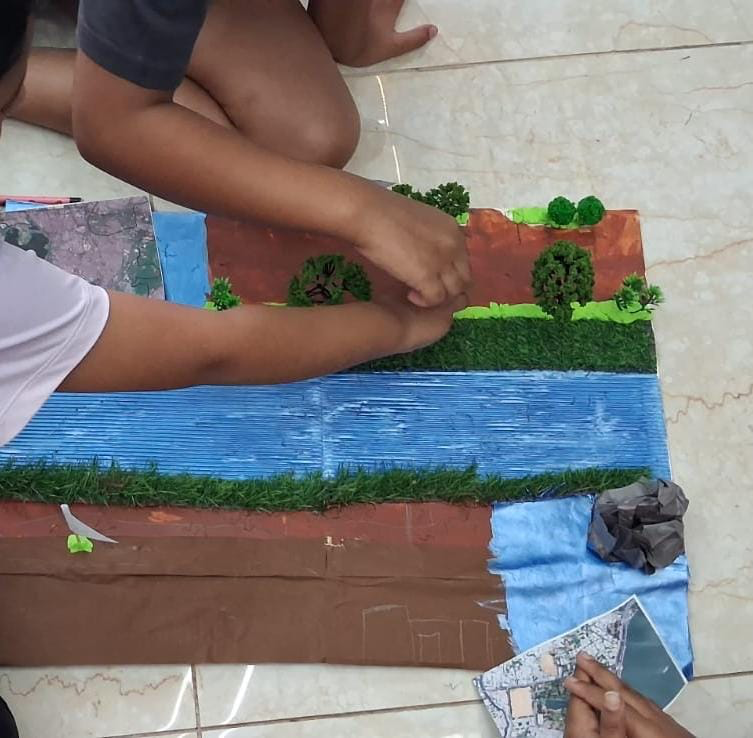
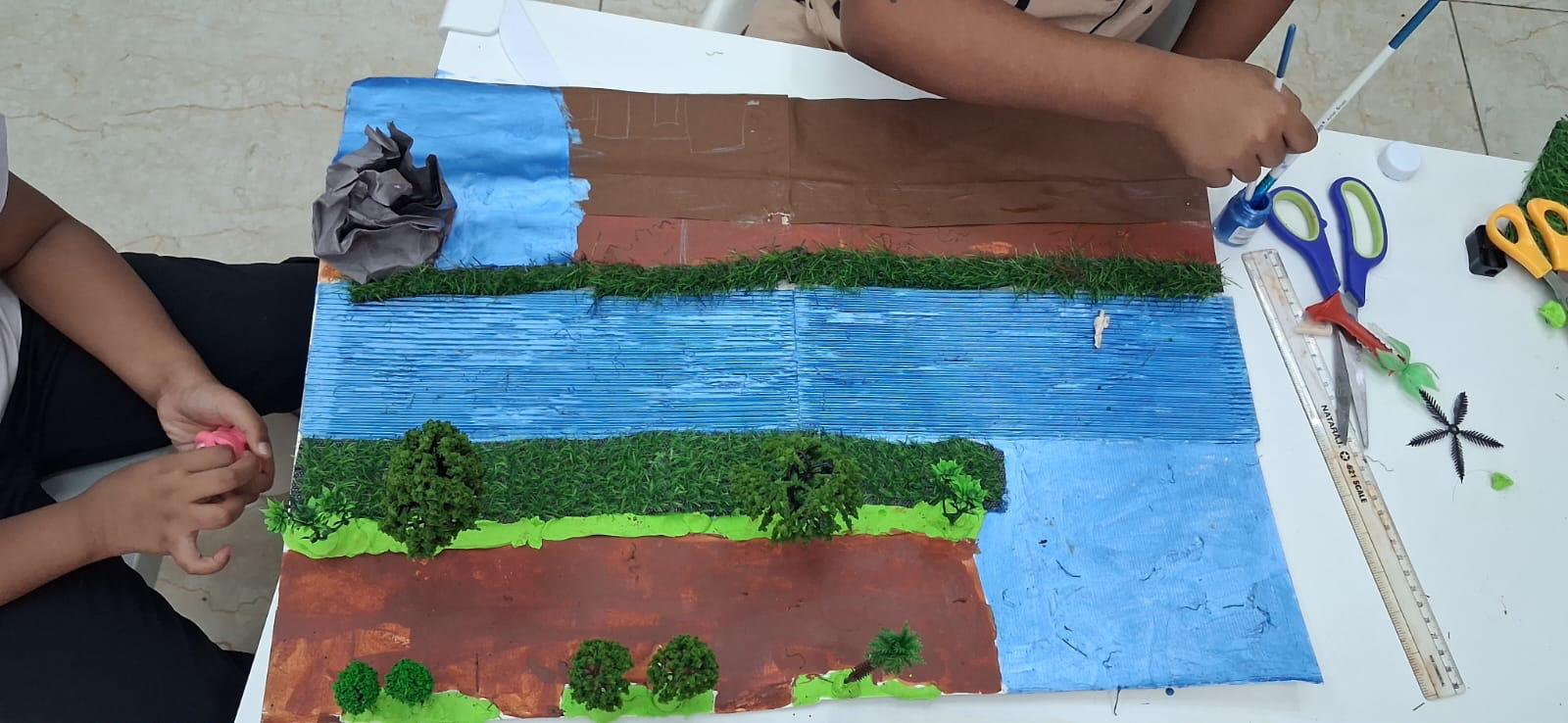
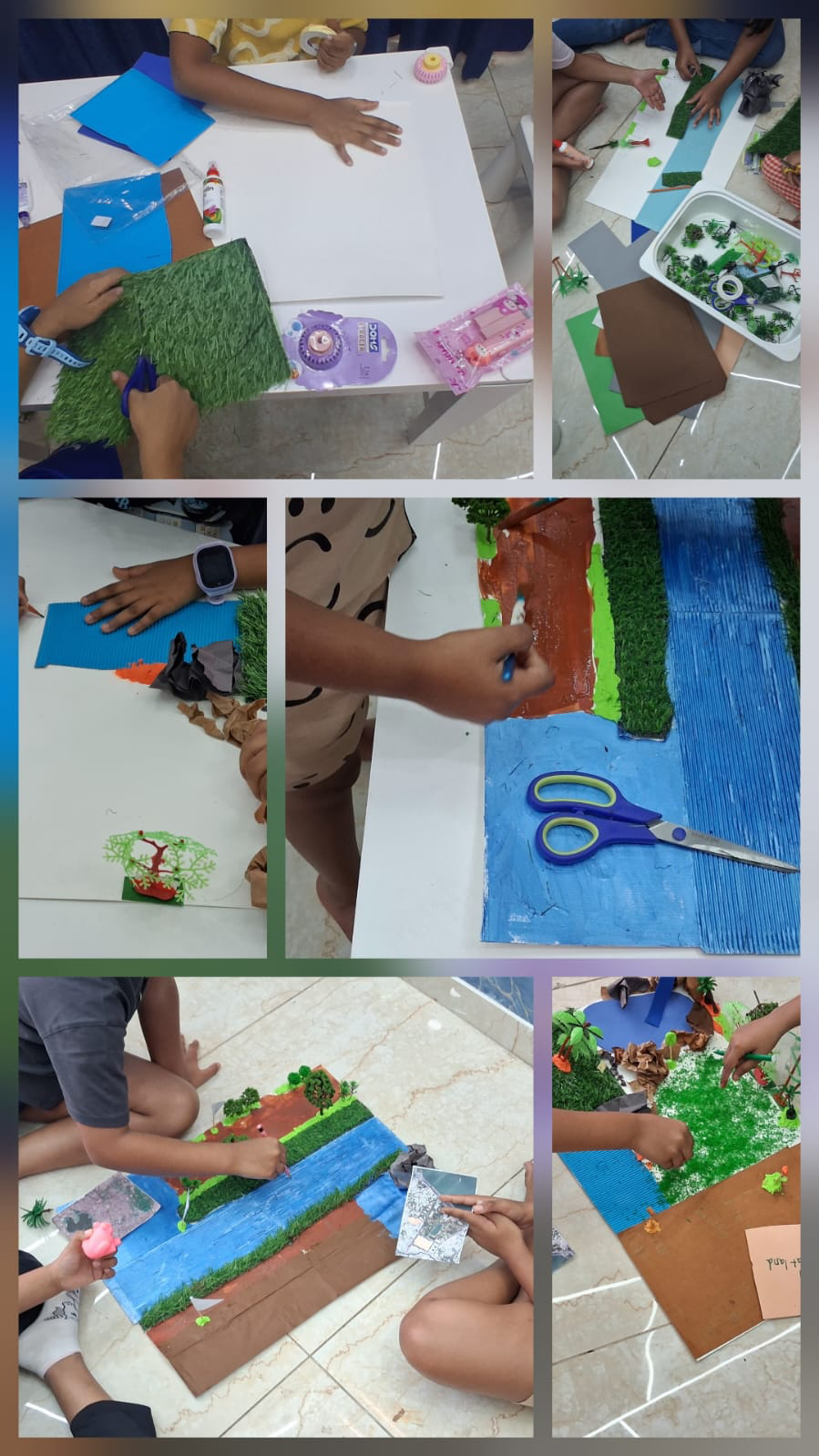
We then moved on to Building Our First Landscape. The children were introduced to an empty baseboard and were asked to imagine looking at a large piece of land from an aeroplane. They explored how the land would look from above, and Samyuktha identified this as an aerial view.
Using colour sheets, foam sheets, paints, cardboard, clay and small plastic trees, the children started creating their landscape. They used blue materials to represent rivers, lakes and ponds, and green materials to show vegetation and green spaces. They also used cardboard and clay to create raised areas representing hills and rocky terrain.
During the activity, the children explored simple concepts such as terrain (the shape and type of land), elevation (how high or low a place is), resources (things people and living things need, such as water) and green spaces (areas with trees, plants and open grass).
Both groups worked together and completed the first phase of their landscape models. While creating their landscapes, they considered where water bodies, flat land, hills and green spaces could be placed, keeping in mind how they could eventually build their city.
Towards the end, the children were introduced to three possible locations for building their city. They placed flags at different spots and began discussing which location would be suitable, considering the availability of flat land, access to water and other natural features.
Both groups completed the first phase of their landscape models. In the next session, they will revisit the three locations, compare their advantages and challenges, and decide which would be most suitable for building their city.
Maira Reddy: 6 years 1 month; Astaya: 7 years 6 months; Yuvan, Mayra and Neev: 8 years 1 month; Havishka and Samyuktha: 8 years 6 months
Dear reader,
My work in education includes designing learning ecosystems where students thrive, teachers grow, and schools build lasting cultures of excellence through innovative curriculum, evidence-based practice, and meaningful educational leadership.
Professional development with Ms Niv: Click below to find the teacher and student workshops and trainings I currently offer:
https://docs.google.com/presentation/d/1ypWO8KpVh56vhYqAMH4XoytLRKMXvwpCAfv3l3fryJQ/edit?usp=sharing
3-2-1 Tuesdays with Ms. Niv is a newsletter you can subscribe to and enjoy your learning journey with me.