Nivedita Mukerjee
Education consultancy for parents and schools
3-2-1 Tuesdays with Ms Niv
Issue #322, 1st September 2026
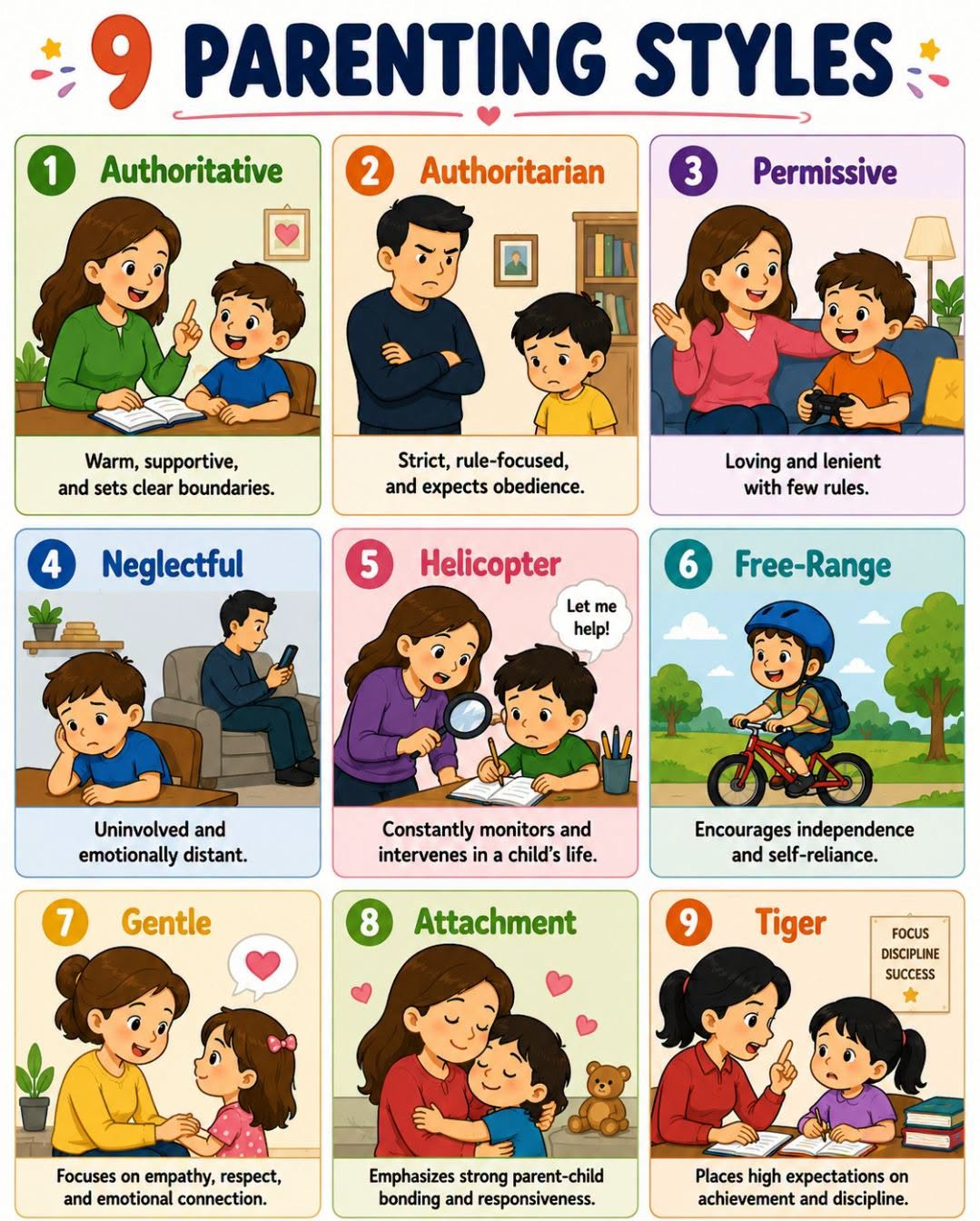
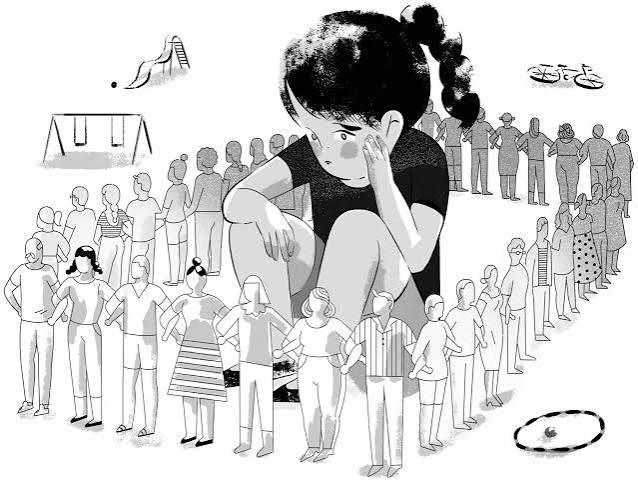
What are your thoughts on ‘Free Range Kids’? The kind that we, our parents, were? Who did quite a few things on our own, without major supervision or adult company? Like going to the neighbourhood store and getting groceries/vegetables, or going on a cycle ride around the city, or going for a picnic nearby on their own without adults? Growing up, we used to regularly go with our neighbourhood kids of varying age groups to cycle around the city with some picnic packed and return by late afternoon after spending the entire day hanging out, playing, eating, chatting, climbing little hills, discovering new roads in the small towns of Jaipur and Gwalior where I grew up.
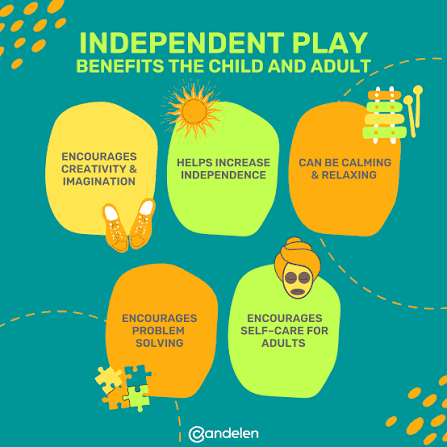
What about free play with no supervision in school? We used to play in the school grounds completely unsupervised while waiting for the second trip of the bus back home, or in the morning when we were on the first trip of the bus and would reach school a good hour before the second trip would come in and the school would actually start.
Is there a scope of this in today’s very anxiety-ridden parenting and school scheduling? Where every minute of every K-12 child is accounted for and organised and supervised by a teacher/parent/assigned adult? What does it do to the development of a child?
Do the children have a right to roam? Have the cities become less child-centric? Have the schools become more restrictive?
This is a free newsletter for parents, educators, and students. If you like my content, please subscribe by entering your email address here.
Three Images of the Week
Two Thoughts of the Week
“You don’t remember the times your dad held your handle bars. You remember the day he let go.”
― Lenore Skenazy, Free-Range Kids: Giving Our Children the Freedom We Had Without Going Nuts With Worry
“The child does not work in order to move or in order to become intelligent. He works to adapt to his environment. It is essential that he has many experiences in the environment if he is to do this. ”
Maria Montessori
The 1946 London Lectures
One Video of the Week
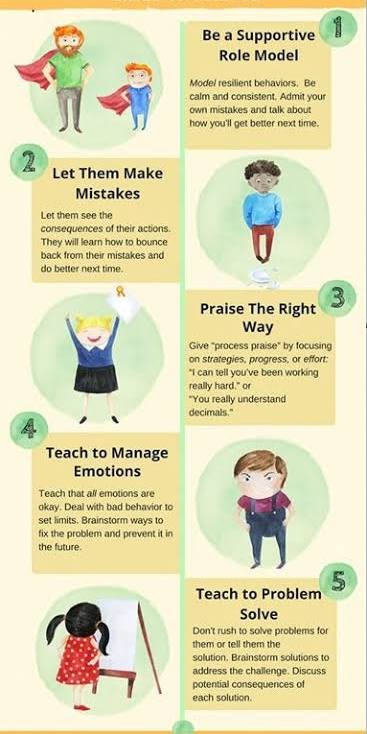
The secret to reducing childhood anxiety is actually quite simple: just let kids do more stuff on their own, says Lenore Skenazy, cofounder and president of Let Grow, an organization dedicated to normalizing childhood independence. In conversation with TED’s Whitney Pennington Rodgers, Skenazy discusses why parenting has become more demanding in our safety-obsessed world — and offers a more joyful, trusting alternative to helicopter parenting, with tangible steps for how to start safely (and sanely) letting your kids grow.
Reading with Ms Meenu: Tip of the Week
The Reading Crisis: Why Long-Form Reading Is Disappearing
For generations, reading a novel, biography, or other long-form book was a common way to spend free time. Today, however, fewer people are choosing to read for pleasure. Researchers, educators, librarians, and publishers have increasingly described this trend as a “reading crisis”—a significant decline in the amount of time people spend reading books and other lengthy texts outside of school or work.
One of the biggest reasons for this decline is the rise of digital entertainment. Smartphones, social media, streaming services, video games, and short-form video platforms offer an almost endless supply of entertainment. Unlike books, which require sustained concentration, digital platforms are designed to provide information and entertainment in seconds. As people become accustomed to quickly scrolling between videos, posts, and notifications, spending several hours focused on a single book can feel increasingly difficult.
This change has also affected attention spans and reading habits. Many people still read throughout the day, but much of that reading consists of text messages, social media posts, headlines, emails, and short online articles. This means people are not necessarily reading fewer words—they are reading in a different way. Long-form reading requires readers to follow complex arguments, remember characters and ideas, and remain focused for extended periods. These skills can weaken when they are used less frequently.
Young people have been particularly affected by this shift. Children and teenagers now grow up surrounded by screens and instant entertainment. Reading must compete with platforms specifically designed to capture and hold their attention. When reading is mainly associated with homework, tests, and mandatory school assignments, students may also begin to see books as work rather than something enjoyable.
Busy lifestyles contribute to the problem as well. Between school, work, commuting, extracurricular activities, and social responsibilities, many people feel that they do not have enough time to read. When free time becomes available, watching a short video or an episode of a television show often requires less effort than beginning a 300-page novel.
The decline in reading for pleasure matters because long-form reading provides benefits that other forms of media may not fully replace. Reading can strengthen vocabulary, comprehension, critical thinking, imagination, and the ability to concentrate. Fiction also allows readers to experience situations from the perspectives of different characters, while nonfiction gives people the opportunity to explore complicated subjects in much greater depth than a short social media post.
Libraries, schools, families, and communities therefore have an important role to play in rebuilding a culture of reading. One solution is to give young people more freedom to choose what they read. Graphic novels, fantasy books, sports biographies, mysteries, comics, and even audiobooks can all serve as gateways into reading. Libraries are also changing by creating comfortable social spaces, hosting book clubs and events, offering digital collections, and connecting books with interests such as technology, gaming, art, and popular culture.
Technology itself does not have to be the enemy of reading. E-books, audiobooks, online reading communities, and social media movements focused on books can introduce new audiences to literature. The challenge is finding ways to use technology to encourage deeper engagement rather than allowing constant digital distractions to replace sustained reading entirely.
The reading crisis is therefore about more than declining book sales or fewer trips to the library. It reflects a broader change in how people consume information and spend their attention. Reversing the trend will require making reading feel relevant, accessible, and enjoyable again. In a world increasingly built around speed and short-form content, choosing to slow down and become absorbed in a book may be more valuable than ever.
Happy Reading!
For more information please visit: placealibrary.ca
Meenu Gera
Consulting Home and School Library Reading Guide
I Think, I Wonder, I Ask
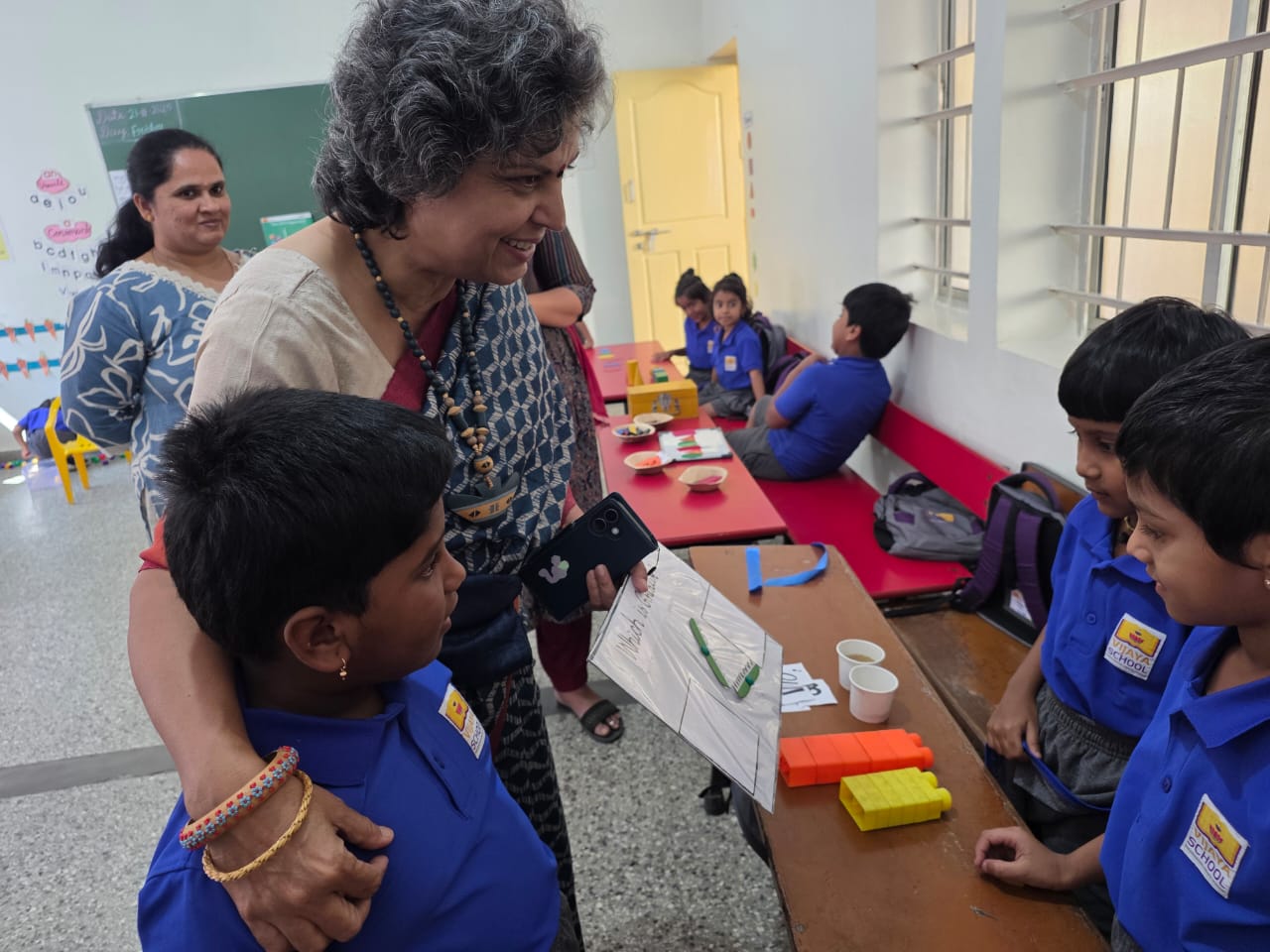
–Dr. Shreelakshmi Subbaswami, Academic Director, Vijaya School, Hassan, Karnataka; https://vijayaschoolhsn.in/
When We Write, We Think Better
Unlike my research writings, over the past year, I have been writing more often, my thoughts, questions, classroom practices, observations and sometimes even the things I am still trying to make sense of. Evidently, writing has made me a better thinker.
Writing was not my go-to tool, but somewhere along the way, it became a thinking tool for me. Just as reading helps us think, writing has helped me slow down, organise my thoughts and make sense of ideas that often feel complicated in my head. It has helped me to pause, question and connect ideas. It also leaves behind a record of how my thinking has evolved. This got me thinking about educators.
How often do educators write? And what do they write?
Some write blogs and reflections, some prepare newsletters, some document classroom experiences and some design worksheets, lesson plans and curriculum materials. When educators actively write about and around the curriculum, they are not merely implementing a curriculum created by someone else. They are also creating, interpreting and shaping curriculum. Perhaps writing can become a professional learning practice, not because every teacher needs to become a writer, but because every teacher needs opportunities to think deeply about what they do.
Three questions for you…
- When was the last time you wrote something that made you think?
- What would you write today if nobody was going to evaluate it?
- How can we provide enough opportunities for teachers to document and share their thinking?
Showcase: Thrive STEAM project, Hyderabad; https://thrivesteam.com/
Pooja Khatter, Facilitator
Exploring Sunlight, Energy and Plants
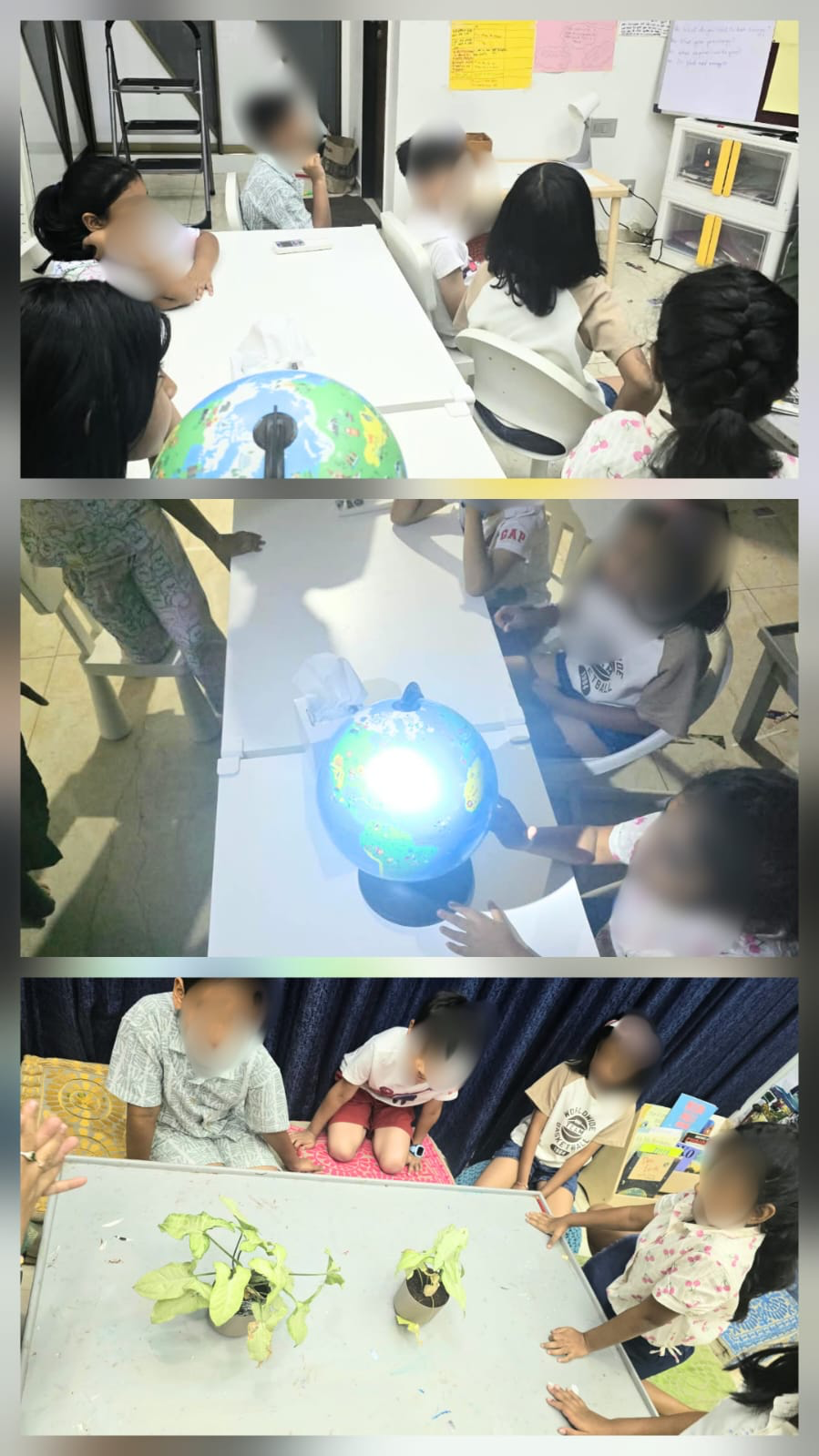
The workshop began by asking the children what they needed to have energy. They responded with food, water, carbohydrates, proteins and fibre. When asked what gave them energy, they mainly mentioned food and water. They identified water, sunlight, soil and air as things plants needed to grow.
The teacher explained that, unlike humans, plants did not get their food from a kitchen. They used sunlight to help make their own food. The children observed a solar panel and understood the connection between solar panels and leaves, as both use sunlight as an energy source.
Using a globe and light source, the children identified the light as the Sun. They observed that the part of the globe facing the light received sunlight, while the opposite side remained dark. They understood that sunlight was an important source of energy for plants and predicted that without sunlight, plants might become weak, stop growing, dry up or die.
The children then compared two plants—one kept in sunlight and the other in a dark cupboard. They noticed differences in the colour and appearance of the leaves. They observed that the plant kept in sunlight looked greener and healthier, while the plant kept in darkness looked weak and lacked energy because it did not receive enough sunlight, water and air. They predicted that the plant kept in darkness might become weaker or die over time.
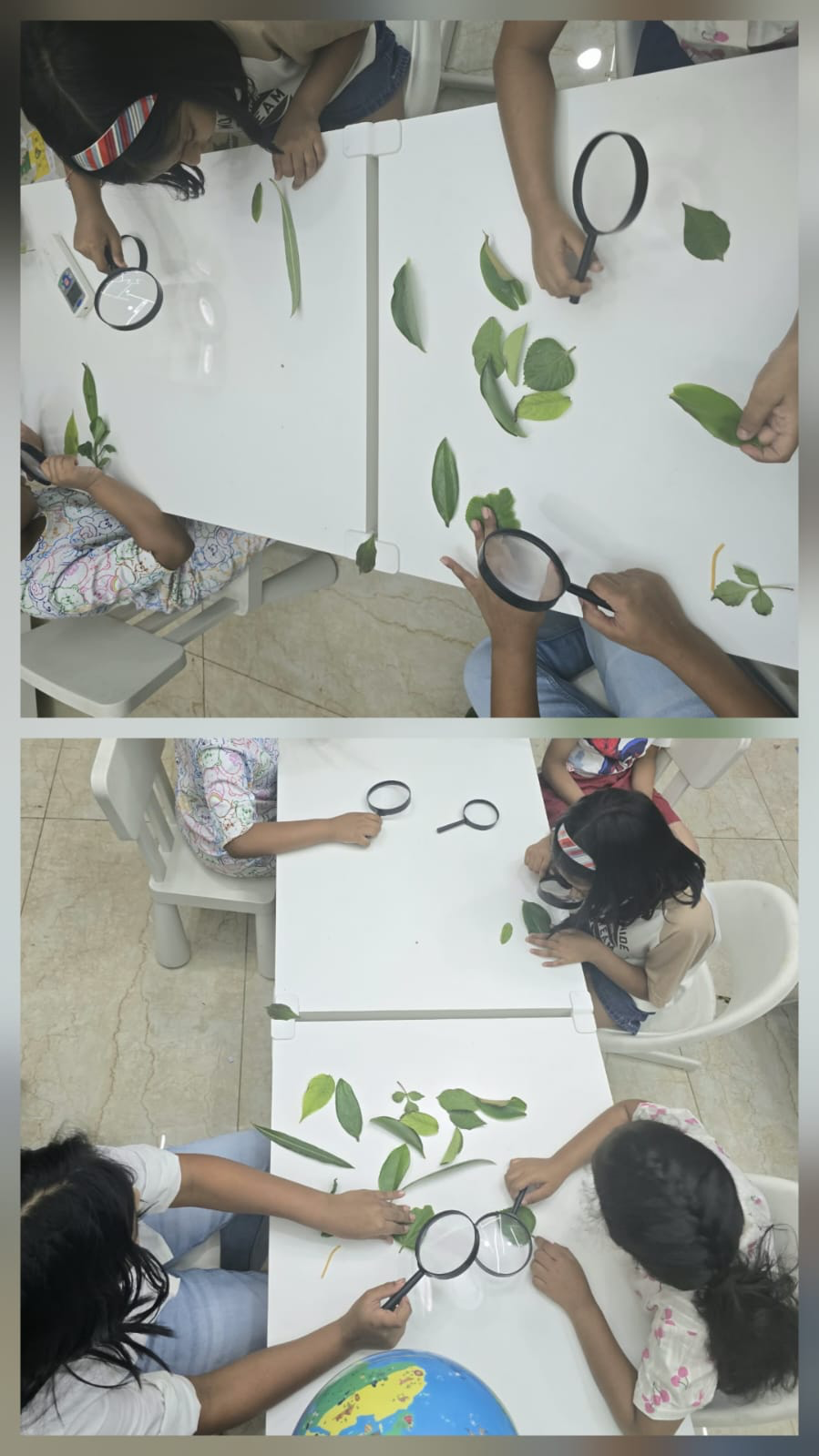
During the leaf exploration, the children noticed that leaves differed in size, shape and texture. They identified the lines on the leaves as veins and learned that veins helped transport water to different parts of the leaf.
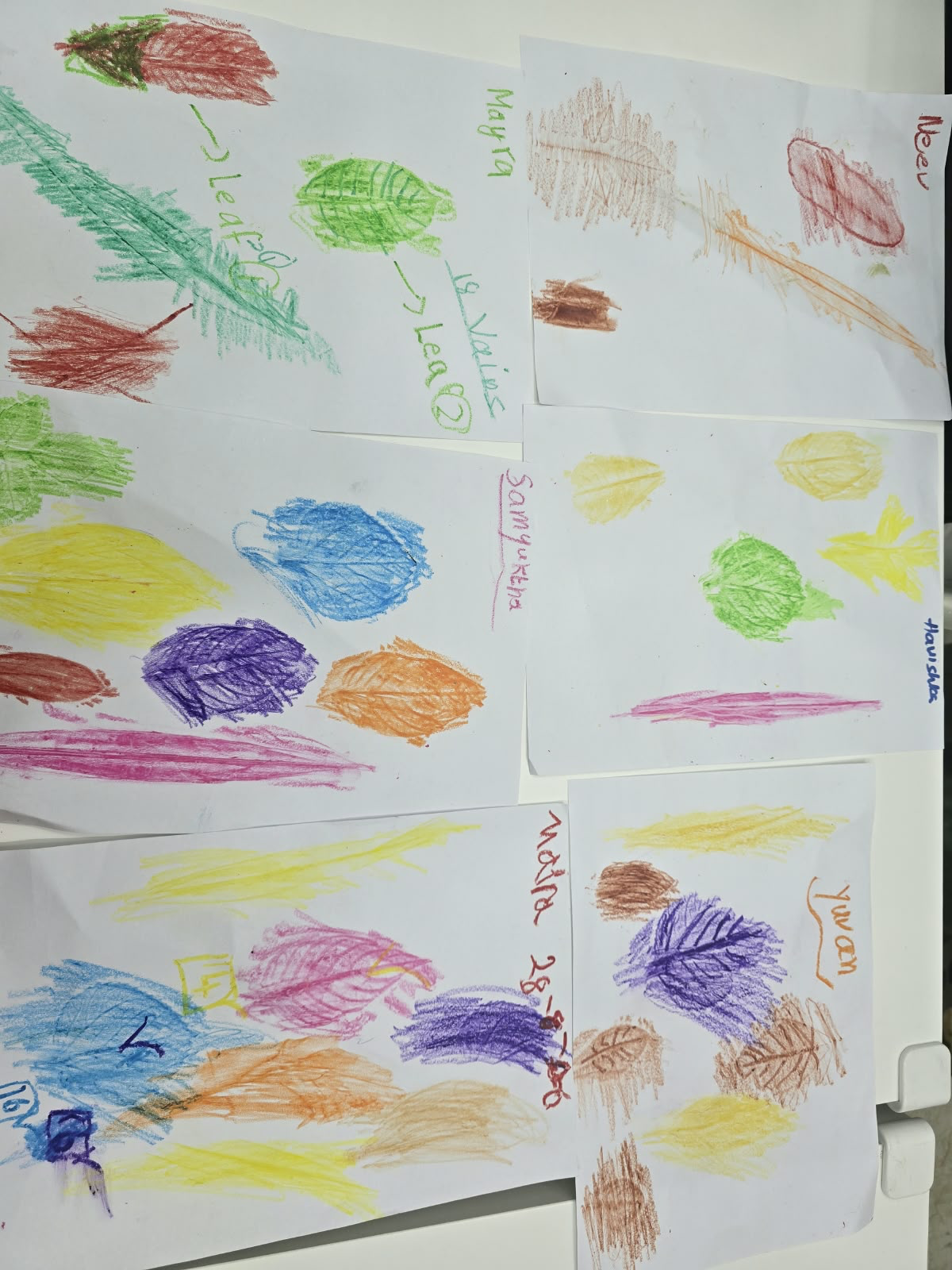
Through the leaf-rubbing activity, the children observed the outlines and vein patterns of different leaves. They noticed that some leaves had thicker main veins, while others had smaller and more branched veins.
Overall, the children were actively engaged and curious throughout the workshop. They shared their ideas, made predictions and connected their observations to their learning. They understood that plants need sunlight, water and air to grow, and that leaves use sunlight and water to help plants make their own food through photosynthesis. Maira:6 years Yuvaan: 7 years 11 months Neev & Mayra: 8 years old Samyuktha & Havishka: 8 years 4 months old
And Finally…
Dear reader,
My work in education includes designing learning ecosystems where students thrive, teachers grow, and schools build lasting cultures of excellence through innovative curriculum, evidence-based practice, and meaningful educational leadership.
Professional development with Ms Niv : Click below to find the teacher and student workshops and trainings I currently offer:
https://docs.google.com/presentation/d/1ypWO8KpVh56vhYqAMH4XoytLRKMXvwpCAfv3l3fryJQ/edit?usp=sharing
3-2-1 Tuesdays with Ms. Niv is a newsletter you can subscribe to and enjoy your learning journey with me.

 Nivedita Mukerjee